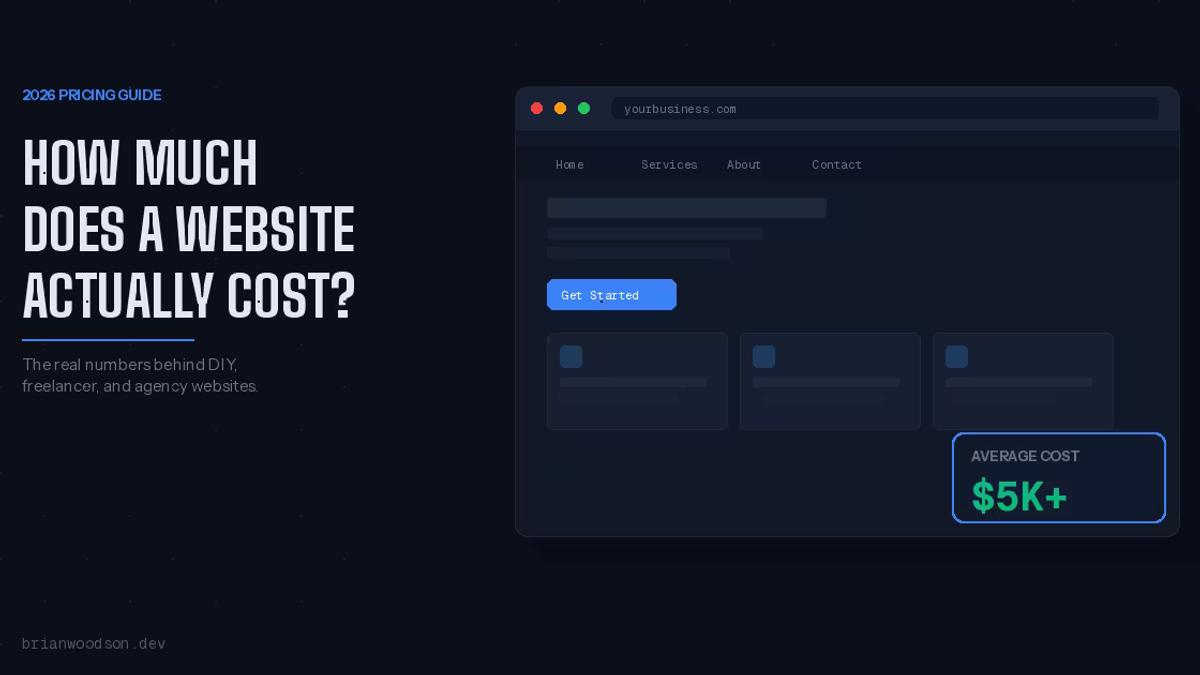
How Much Does a Small Business Website Actually Cost in 2026?
Most small business owners either overpay for a website that underperforms — or underpay for one that quietly loses them customers every day.
If you're Googling website costs, you're already ahead of most. But the price tag on the invoice is only half the story. What matters is what that money gets you — and what cutting corners actually costs your business in lost leads, lost trust, and lost revenue.
Here's the real breakdown.
The Three Pricing Tiers (And What You Actually Get)
DIY Website Builders: $0–$300 upfront, ~$10–$30/month
Squarespace, Wix, GoDaddy — you've seen the ads. They're cheap, they're fast, and for a business that just needs something online while it figures things out, they work.
But "works" is doing a lot of heavy lifting. Template-based sites look like template-based sites. Your customers can tell. Your competitors who invested more? They look more established, more trustworthy, more worth calling. That's not a design opinion — that's how buyers make decisions.
Use a DIY builder when: You need a placeholder fast and plan to upgrade within 6–12 months.
Freelancer / Independent Developer: $500–$5,000
This is the sweet spot for most small businesses. A good freelancer gives you a semi-custom or fully custom site with real design work, mobile optimization, and basic SEO — without the overhead of an agency.
The range is wide because scope matters. A clean 5-page service site is a different project than a 15-page site with booking integrations and a blog. The key is finding someone who scopes the project tightly and delivers a site that actually converts — not just one that looks nice in a screenshot.
Use a freelancer when: You want a professional site that reflects your business, you have a clear idea of what you need, and you don't want to pay agency markup for work one skilled developer can handle.
Agency: $5,000–$15,000+
Agencies bring teams: designers, developers, project managers, copywriters. For complex builds — e-commerce stores, membership platforms, multi-location businesses — that infrastructure makes sense.
For a standard small business site? You're often paying for overhead, not output. A $12,000 agency site and a $4,000 freelancer site can perform identically if the freelancer knows what they're doing.
Use an agency when: Your site is genuinely complex, you need ongoing strategic support, or your business is large enough that the website is a core revenue engine.
The Costs Nobody Tells You About
The sticker price gets you the build. Here's what comes after:
Domain name: $10–$20/year. Cheap, non-negotiable, easy.
Hosting: $100–$600/year depending on the plan. Cheap shared hosting might save you $40/month — and cost you 2 seconds of load time. That trade-off is worse than it sounds (more on that below).
SSL certificate: Usually free now through your host. If someone's charging you $100/year for SSL in 2026, ask questions.
Maintenance and updates: $30–$200/month. This covers security patches, plugin updates, backups, and the small fixes that keep a site running. Skip this and you'll eventually wake up to a broken site or a security breach. Budget $360–$2,400/year.
Plugins and software licenses: $200–$600/year for a typical business site. SEO tools, form builders, booking widgets, analytics — the tools that make a site functional aren't always free.
Content refreshes and redesigns: Your site will need a refresh every 2–4 years. Budget 20–40% of the original build cost for that cycle. A site that looked modern in 2024 will feel dated by 2027.
Add it all up and a small business website costs roughly $1,500–$5,000 to build and $500–$2,500/year to keep running properly. Knowing that upfront prevents the slow bleed of surprise invoices.
Why Speed Isn't a "Nice to Have" — It's a Revenue Decision
This is where most business owners underestimate what's at stake.
Google found that 53% of mobile visitors leave a page that takes more than 3 seconds to load. Not some of them. More than half.
The data gets more specific — and more painful:
A site that loads in 1 second converts at roughly 40%. At 2 seconds, that drops to 34%. At 3 seconds, 29%. Every second you add is money walking out the door.
One case study showed that shaving 1 second off load time increased conversions by 14%. Another estimated a 760% ROI on performance optimization investment.
And it's not just conversions. Google's Core Web Vitals — loading speed, interactivity, visual stability — are official ranking factors. A slow site ranks lower, which means fewer people find you in the first place.
The bottom line: A $3,000 site on fast hosting with optimized images and clean code will outperform a $10,000 site on cheap hosting with bloated plugins every single time. Performance isn't a feature. It's the foundation.
What a High-Converting Small Business Site Actually Includes
Not every website is built to generate leads. Here's what separates a site that converts from one that just exists:
Mobile-first responsive design. More than half your visitors are on phones. If the site isn't built for mobile first, you're designing for the minority.
Speed optimization. Compressed images, minimal scripts, fast hosting, a CDN if needed. Target under 2 seconds for your largest content to load.
Clear branding and positioning. Within 5 seconds, a visitor should know what you do, who you do it for, and why they should care. Professional visuals, testimonials, and a clear value proposition make that happen.
SEO foundations. Keyword-optimized titles and meta descriptions, proper heading structure, image alt text, a submitted sitemap, and Google Analytics connected from day one.
Intuitive navigation. Simple menu, clear labels, no more than 5–7 top-level items. If a visitor can't find your services page in 2 clicks, your navigation is failing.
Calls-to-action on every page. "Request a Quote." "Schedule a Call." "Get Started." Prominent, repeated, impossible to miss. A site without CTAs is a brochure — not a sales tool.
Trust signals. SSL certificate (the padlock in the browser), a privacy policy, real testimonials or case studies, and professional design that signals you're legitimate.
Every item on that list adds to cost. Every item you skip silently costs you leads.
What a Realistic Timeline Looks Like
A custom small business site typically takes 8–12 weeks from kickoff to launch when working with an agency:
Weeks 1–2: Discovery. Define goals, map out pages, outline content, identify target keywords.
Weeks 3–5: Design. Wireframes, then full mockups for desktop and mobile. This is where the look and feel gets locked in.
Weeks 6–9: Development. The site gets built, CMS gets configured, content goes in, and performance gets optimized.
Week 10: Testing. Cross-browser, cross-device testing. Speed checks. Form testing. SEO verification.
Week 11: Launch. Final review, DNS switch, analytics confirmation, and handover.
Freelancers and independent developers can often move faster — especially with a fixed scope and clear deliverables. The timeline depends less on who builds it and more on how well the project is defined upfront.
Three Packages, Three Price Points
To give you a realistic sense of what different budgets buy across the market:
Basic Website — ~$1,500. 5–7 pages (Home, About, Services, Contact, etc.), template-based design with light branding customization, mobile-friendly, basic SEO setup. No e-commerce. Gets you online with a professional foundation.
Standard Website — ~$5,000. ~10 pages with custom or semi-custom design, professional branding integration, mobile-first responsive build, on-page SEO with keyword research, contact form and lead capture, performance-tuned hosting. Built to generate leads, not just look good.
Premium Website — ~$12,000. 15+ pages including blog or gallery, fully custom design and UX, advanced features (e-commerce, booking system, integrations), comprehensive SEO with structured data, CDN and code optimization, copywriting included, and ongoing maintenance support. For businesses where the website is a core revenue channel.
These are industry averages. What you actually pay depends on scope, features, and who you hire. The important thing is knowing what each tier gets you — so you're comparing deliverables, not just price tags.
The Real Question Isn't "How Much Does a Website Cost?"
It's "how much is a bad website costing you right now?"
Every day your site loads slowly, looks outdated, or fails to tell visitors what to do next — that's revenue you're not capturing. That's a customer who went to your competitor instead. Not because they're better. Because their site made it easier to say yes.
A website isn't an expense. It's either working for your business or working against it. There's no neutral.
Ready to find out what your business actually needs? Get a free quote →
Want to see what a high-performance site looks like? View real project results →