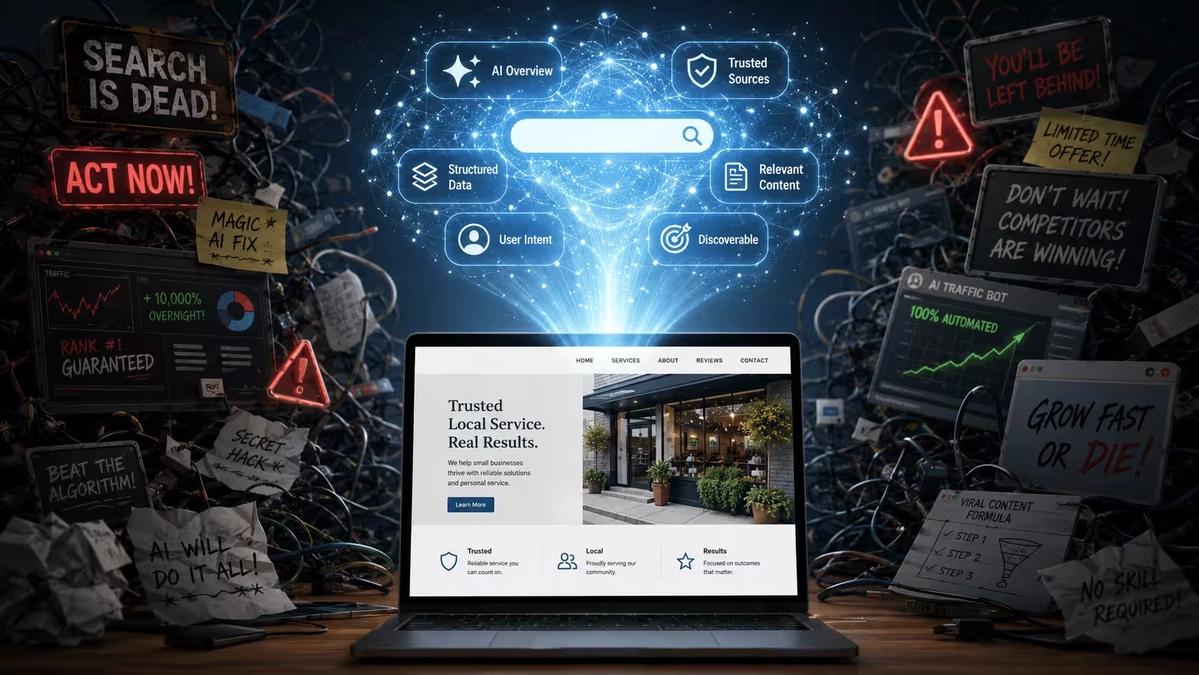
Over the past few months, "AI visibility" went from a term almost nobody used to something every marketing newsletter wants to sell you a fix for. The pitch is always the same. Search is dying, AI is eating it, and if you do not act right now you will vanish. Some of that is true. Most of the panic is not. Here is the honest version, written for a business owner who wants to know what to care about and what to ignore.
What AI visibility actually is
When someone asks ChatGPT, Perplexity, Gemini, or Google's AI Overviews a question, they often get a written answer instead of a page of blue links. AI visibility is whether your business shows up inside that answer. It might be a direct recommendation, a citation linked at the bottom, or simply the model describing your category in a way that happens to fit you.
The part most people miss is how those answers get built. These tools do not pull recommendations out of thin air. When you ask a live question, the tool runs a web search in the background, reads a handful of pages, and writes a summary that cites them. That means the same search ranking you already care about is doing most of the work. If your site ranks well and reads clearly, it tends to get pulled into the answer. If it is buried on page eight, the AI never finds it, the same way a person never finds it.
There is a second path, which is the model's trained knowledge and how often your name appears across the web. That one moves slowly and you cannot edit it directly. For a small business, the live search path is the one that matters.
How it can actually help
The useful version of this is simple. People increasingly ask an AI for a shortlist before they ask a human. Who builds custom websites for small businesses. Is WordPress a good choice for a contractor. How much should a website cost. If your site is the one the AI reads while answering, you get mentioned at the exact moment someone is deciding, which is earlier in the process than a normal search click. The AI is effectively vouching for you by including you at all.
This matters more for considered purchases than for impulse ones. Nobody asks ChatGPT which gas station to stop at. Plenty of people ask it how to choose a web developer, an accountant, or a contractor for a commercial job. If that sounds like your customers, being present in those answers is worth something real.
I want to be honest about the size of it, though. For most local service businesses today, AI still drives a small fraction of the inquiries that ordinary search and referrals do. It is growing, and it is worth setting yourself up for, but anyone telling you it is already your main channel is selling something.
Where the hype falls apart
Here is the part nobody in the AI marketing world wants to say out loud. A large share of what gets sold as "AI visibility optimization" is repackaged SEO at a higher price, plus a few tactics that do not work yet.
The clearest example is a file called llms.txt. The idea is that you put a special text file on your site telling AI models which pages matter, similar to the robots.txt file that search engines have used for years. Vendors have been pushing it hard. The reality, as of now, is that it does close to nothing. No major AI company, including OpenAI, Google, Anthropic, and Meta, has committed to reading it in their live products. Google has said plainly that it does not use the file, and one of its search engineers compared it to the old meta keywords tag, which is a polite way of calling it pointless. When researchers checked server logs, the AI crawlers almost never requested the file at all. One study found it made up roughly one in a thousand AI bot visits. It costs almost nothing to add, so there is no harm in having one. But if someone charges you for it as a visibility strategy, that is your tell that you are dealing with hype.
The broader pattern is worth naming. A whole industry of tools and audits appeared almost overnight, most of them promising to track and boost your AI mentions. Some of the tracking tools are genuinely useful. A lot of the rest is fear marketing aimed at owners who do not have time to check the claims. The formal term for all of this, generative engine optimization, comes from a research paper published in 2024. The field is barely two years old, and people are already selling certifications in it. Treat that the way you would treat any gold rush.
What you actually need to know
Strip away the noise and only a few things matter, and most of them you should be doing anyway.
Make sure you are not accidentally blocking the AI crawlers. They use specific names like GPTBot, ClaudeBot, and PerplexityBot. If those are blocked, you cannot be cited, period. This catches more sites than you would expect, because some hosting providers and security services, Cloudflare among them, started blocking AI bots by default. It is worth a quick check with whoever manages your site.
Your content also has to be readable by a machine. AI crawlers read the raw page your server sends. They do not click around or wait for heavy scripts to finish loading. If your important information only appears after a pile of JavaScript runs, or it sits behind a login, the AI cannot see it. A properly built site serves real text up front, which is one more reason the way a site is built still matters.
Structure your pages so an answer can be lifted straight out of them. Put the direct answer near the top. Use headings that match the questions people actually ask. Include the basic facts about your business, your location, and your services in a clean, labeled format that machines can parse. Some studies suggest pages with that kind of structured markup get pulled into AI answers noticeably more often. It also happens to help with normal search, which is the running theme here.
Build a reputation the AI can find in more than one place. These systems lean toward businesses that show up across reviews, directories, and articles that mention them by name. A small business does not win this by outspending a national brand. It wins by being clearer and more specific about exactly what it does and who it serves.
Last, measure it the cheap way before you pay anyone. Write down the ten or fifteen questions a good customer would ask, then go ask ChatGPT, Perplexity, and Gemini those questions yourself. See whether you come up, who shows up instead, and how you get described. That will tell you more than most paid dashboards, and it costs you an afternoon.
The short version
AI visibility is real and worth a little of your attention. It is also being wildly oversold by people who profit from the worry. The good news for a business owner is that almost everything that actually moves it is the same work that has always paid off: a fast, well built site, clear and honest content, and a real reputation. Do those things and you are most of the way there already. Ignore anyone who tells you the answer is a magic file or a monthly subscription to a tool you do not understand.