AI Website Builders for Small Business: What the Sales Pitch Leaves Out
Every few months, another platform rolls out an AI website builder with a slick demo and a promise: describe your business, click a button, and your website is live in minutes. No developer needed. No technical knowledge required. Just type what you do and let the machine handle the rest.
For small business owners across Texas -- whether you're running a service company in Granbury, a contracting outfit in Weatherford, or a retail shop in Cleburne -- that pitch is landing harder than ever. The cost sounds right. The speed sounds right. And when you're trying to run a business, anything that gets the website off your plate feels like a win.
But the companies selling these tools have a different definition of "done" than you do. Done for them means published. Done for you means ranking, converting, and driving revenue. Those are not the same thing, and the gap between them is where small businesses quietly lose ground every month.
This is the breakdown you won't find on the pricing page.
The Platforms Making the Pitch
These aren't fringe products. The AI website builder push is coming from some of the biggest names in the industry.
Wix ADI (Artificial Design Intelligence) has been around longer than most. You answer a series of questions about your business, and Wix generates a site from its template library. The newer version layers in AI text generation and image placement. It's probably the most polished version of this concept on the market.
GoDaddy Airo is GoDaddy's answer to the AI moment. It generates a one-page site from your business name and category, pulls in AI-written copy, and gets you to a published URL faster than any competitor. That speed is a feature. It's also part of the problem.
Squarespace Blueprint AI walks you through a guided setup that uses AI to assemble layouts and generate copy based on your answers. It's more hands-on than some of the others, but the end result is still a template populated by a machine.
Framer AI is aimed slightly more at designers and tech-forward users, but it's increasingly being positioned as a no-code site builder for anyone who can write a prompt. You describe what you want and Framer generates the page structure, sections, and sometimes the copy.
Hostinger Horizons and Jimdo Dolphin round out the category for the budget-conscious market -- both offer some version of "describe your business, get a website" with minimal friction.
These platforms aren't identical, and some are more capable than others. But they share the same foundational approach: AI generates the structure, copy, and layout based on your inputs, and the result is published with minimal human review. That's where the problems start.
What AI Builds. What It Doesn't Understand.
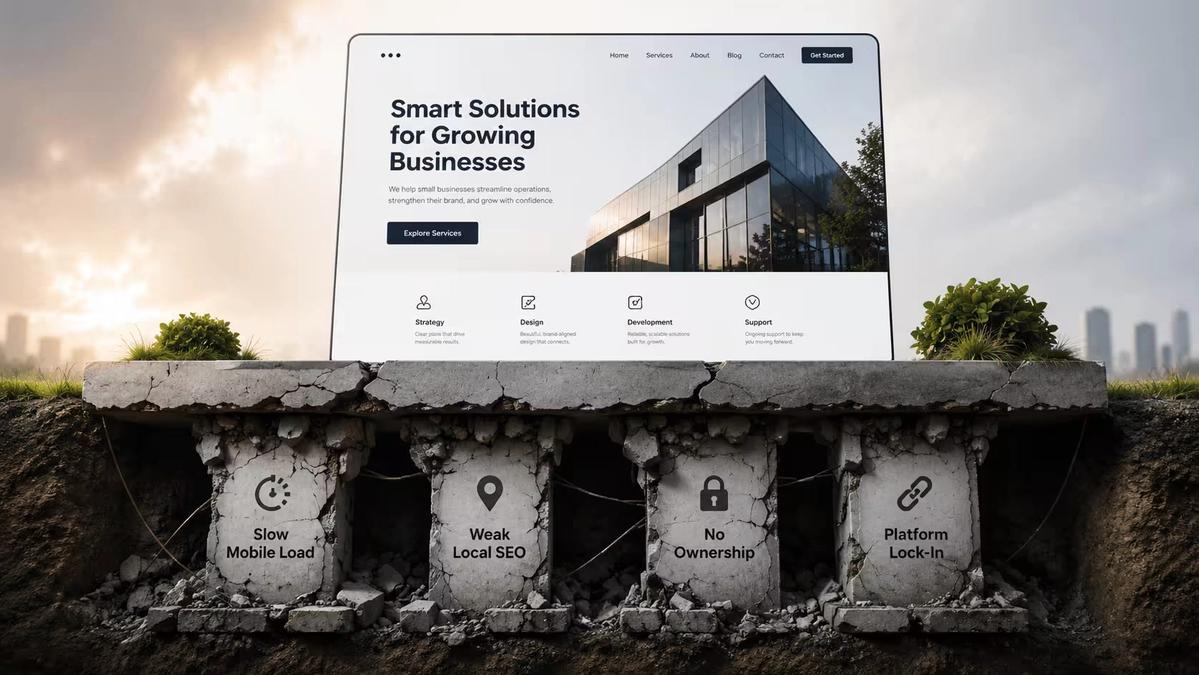
1. Performance and Core Web Vitals
Google's ranking algorithm uses Core Web Vitals as a direct signal. Largest Contentful Paint, Cumulative Layout Shift, Interaction to Next Paint -- these are measurements of how fast and stable your site feels to a real visitor on a real device. They affect where you show up in search results and how much you pay when you run ads.
AI-generated websites don't optimize for these metrics. The code is generated to work, not to be fast. Images are dropped in at whatever size the template assumes. Scripts load in whatever order the platform defaults to. Nobody reviewed the output for render-blocking resources, unnecessary dependencies, or oversized payloads.
The result is a site that loads slowly on mobile, shifts around while it renders, and scores poorly on Google's PageSpeed Insights tool. In a competitive local market -- whether that's Hood County, Parker County, or anywhere in the DFW area -- that's a ranking disadvantage baked into the foundation. In paid search, it's a Quality Score penalty that makes every ad dollar less effective.
Professionally built sites can consistently hit 95 to 100 across all four Lighthouse performance categories. AI-generated sites rarely come close, and the platform gives you limited ability to close that gap.
2. Security
Security vulnerabilities in websites aren't visible on the frontend. They show up when something goes wrong -- a breach, a redirect hack, a contact form being used to send spam, customer data exposed. By then the damage is done.
AI code generators produce plausible-looking code. That's different from hardened code. The model pulls from patterns in its training data, including patterns that look reasonable but contain known exploitable weaknesses. Because no professional reviewed the output with security in mind, those weaknesses ship with the site.
On top of that, AI website platforms run on shared infrastructure that updates on the platform's schedule, not yours. If a vulnerability is disclosed in a library the platform depends on, you're waiting on the platform to patch it. You have no visibility into when that happens or whether your site was exposed in the meantime.
A site built on a deliberate stack, with careful dependency management and a developer who understands what they're deploying, is a different situation entirely.
3. Local SEO -- The One That Hurts Most
This is where the gap between "we have a website" and "our website works" becomes most expensive -- and most invisible.
For a small business trying to win local customers, ranking in search isn't about having a website. It's about having the right signals in the right places so Google understands who you are, what you do, and where you serve. AI website builders don't build those signals. They build a generic business website and call it SEO-ready.
Here's what that actually means in practice.
A roofing company in Granbury is competing for searches like "roofing contractor Granbury TX" and "roof replacement Hood County." Winning those searches requires more than having those words somewhere on the page. It requires proper schema markup that tells Google your business type, service area, and physical location. It requires location-specific page structure, not a template with the city name dropped into the headline. It requires internal linking that reinforces what you do and where you do it. It requires copy written around how real customers in that area actually search -- not generic industry language an AI produces from a prompt.
The same applies in Weatherford, Cleburne, Stephenville, or anywhere else in the region. Local search is won at the technical and structural level. AI builders handle the surface -- title tags, meta descriptions, basic keyword placement -- and miss everything underneath.
The painful part: bad local SEO isn't immediately obvious. Your site looks fine. Your business name comes up when someone searches for it directly. But when a potential customer in your service area searches for what you do without knowing your name, you're not there. That's invisible revenue loss, and most business owners don't trace it back to the website until months of flat results force the question.
4. Ownership and Lock-In
When you build a site on Wix, GoDaddy Airo, Squarespace, or any proprietary AI platform, you don't own the underlying system. You own access to a product. Those are very different things.
If the platform raises its prices, your only option is to pay or rebuild from scratch. If the platform is acquired, pivots, or shuts down -- it has happened, and it will happen again -- you lose what you built. If you want to move to faster infrastructure or a different CMS down the road, the export tools give you partial content at best. The design, the structure, the integrations -- those stay behind.
A custom-built website on your own domain, deployed to infrastructure you control, with a CMS that stores your content in a portable format, is something you actually own. It moves with you. It scales with you. It doesn't disappear if a company decides to restructure its product line.
5. No Accountability Layer
This is the issue nobody in the AI builder space wants to talk about openly.
When an AI platform generates your site, no professional is responsible for the outcome. The platform's terms of service make this explicit -- they provide the tool, you accept the results. If the copy is factually wrong, the performance is poor, the local SEO is broken, or something on the site creates legal exposure (ADA compliance, missing privacy disclosures, GDPR), that's on you.
When you work with a professional web developer, there's a person who understands what was built, can explain every decision, and can fix what breaks. There's someone you can call. There's someone whose reputation is on the line alongside yours.
That accountability isn't a luxury. It's what makes a website a business asset rather than a liability.
What Happens to Businesses That Don't Address This
Let's be direct about the trajectory -- because it follows a consistent pattern.
A business launches an AI-generated website and calls it done. The owner is relieved to have something live. Traffic is minimal because the local SEO was never actually built. Months pass. The owner runs Google Ads to compensate, spending money to drive traffic to a slow, generic site that doesn't convert well. The ad spend doesn't produce the expected return. Meanwhile, a competitor with a properly built site -- maybe another contractor in Granbury, another service company in Weatherford -- is climbing the organic rankings for the searches that matter and getting calls without paying for every click.
Eventually something breaks. A platform update changes the layout. A mobile display issue appears and stays there. There's no developer to call. Platform support can help with platform-level problems, not custom ones. The business owner either lives with it or starts over from scratch.
Or the situation gets worse: a search algorithm update penalizes the site for thin content, slow load times, or poor mobile experience. Rankings drop. The owner doesn't understand why. The AI platform has no answer.
None of this is hypothetical. It's the pattern that keeps appearing for businesses that treat their website as a checkbox rather than an asset -- and it's playing out right now for businesses across the DFW area who launched on one of these platforms and are wondering why the phone isn't ringing.
What a Professional Build Actually Gets You
A website built by an experienced web developer isn't just code. It's a considered system built to work for your specific business in your specific market.
Performance is engineered from the start. Every image is optimized. Every script is evaluated for necessity and load order. Lighthouse scores in the 95-to-100 range aren't accidents -- they're the result of deliberate decisions at every stage of development, tested across devices and connection speeds before anything goes live.
Local SEO is built into the architecture. The right keywords inform the copy before a word is written. Schema markup tells Google your business type, service area, physical location, and operating hours in structured data it can parse reliably. If you're serving Granbury, Weatherford, Cleburne, and Stephenville, that geographic relevance is built into the site from the ground up -- not added as an afterthought.
Security is handled intentionally. Dependencies are chosen carefully. The stack is reviewed against known vulnerabilities before launch. You're not dependent on a platform's patch cycle.
And when something needs to change -- a new service line, a new city you're expanding into, a seasonal campaign, updated pricing -- there's a developer who knows the system and can make that change correctly. Not re-prompt an AI and hope the output is consistent with what's already there.
If Your Website Is Supposed to Work for You, Make Sure It Does
The AI website builder pitch makes sense if you think of a website the way you think of a business card -- something to have, not something to earn revenue.
But for a service business competing for customers in Granbury, Fort Worth, or anywhere across North Texas, your website is closer to a full-time salesperson who works around the clock. It's the thing people land on after they Google what you do. It's what earns or loses the call before you ever pick up the phone.
That's not something to hand off to a tool that generates plausible output and calls it done.
If you're not sure whether your current website is working for you or against you, we offer a free site audit covering performance, local SEO fundamentals, and technical health -- no pitch attached, just an honest look at where things stand.
Request Your Free Website Audit
Or if you're ready to talk about a build that's built to last and built for your market: