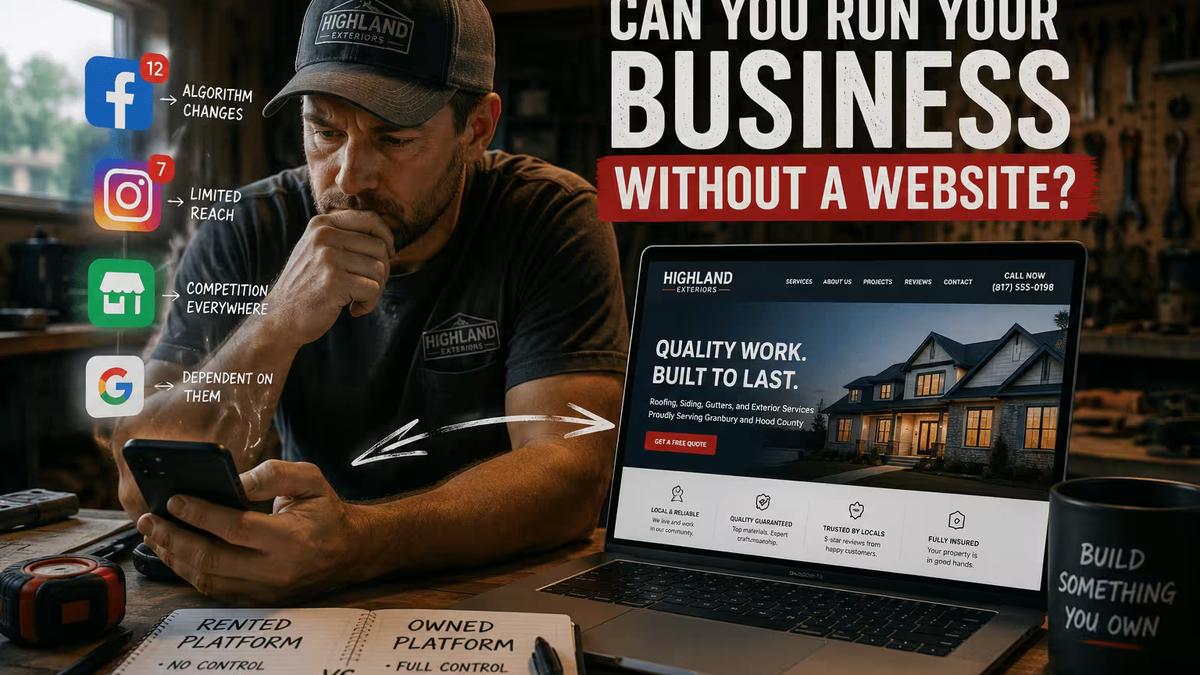
The honest answer is yes. Plenty of businesses do it. Granbury has no shortage of contractors, cleaners, and tradespeople who have been closing jobs through Facebook, phone calls, and word of mouth for years without a single web page to their name.
So if you are hoping someone will tell you that you absolutely cannot survive without a website, I am not going to do that. That argument is too easy to disprove, and the second a reader thinks of a counterexample, you have lost them.
The better question is this: what are you actually building when you rely entirely on platforms you do not own?
The Businesses That Get Away With It
Social media, referrals, and third-party marketplaces work. At least initially. A pressure washing company with a solid Facebook following and a good reputation in a local neighborhood Facebook group can stay busy. A tattoo artist with a strong Instagram portfolio does not necessarily need a separate website. A food truck running DoorDash gets customers without owning the relationship.
The model works because these platforms lower the barrier to entry. You get instant visibility without building anything from scratch. Referrals compound on their own once you do good work. Marketplaces bring the traffic.
That is a real advantage and it would be dishonest to pretend otherwise.
The problem is not that the model fails. The problem is where it stops.
You Are Building on Land You Do Not Own
Every business operating exclusively on Facebook, Instagram, or a third-party marketplace is operating on borrowed infrastructure. The platform owns the audience. The platform sets the rules. The platform decides, through algorithm changes, policy updates, or simple account errors, how visible you are on any given day.
This is not hypothetical. Facebook reach for business pages has been declining for years. Accounts get suspended, hacked, or buried without warning and without recourse. Etsy has repeatedly changed its fee structures and search algorithms in ways that devastated sellers who built their entire business there. Google Business Profiles get flagged, suspended, or merged incorrectly more often than most business owners realize.
When your entire customer acquisition strategy lives inside someone else's platform, you are not running a business. You are operating inside someone else's business and hoping the terms stay favorable.
A website is infrastructure you control. The content does not disappear because an algorithm shifted. The contact form does not stop working because someone reported your account. The service pages you built two years ago are still there, still indexed, still working for you at 2 in the morning.
That distinction is not abstract. It is the difference between an asset and a rental.
Referrals Are Excellent. They Are Also Fragile.
This is the objection I hear most from small businesses in markets like Granbury and the surrounding Hood County area. "We get most of our work through referrals. We stay busy. We don't need more."
Referrals are the best kind of lead. They arrive pre-sold. They trust you before they call. The close rate is dramatically higher than any other source.
But referrals are not a system. They are a byproduct of past work, and they are vulnerable in ways that are easy to ignore when business is good. Economic slowdowns reduce discretionary spending and referrals dry up faster than search traffic does. Key referral sources move, retire, or shift their recommendations. A single bad season can create a gap that a referral network cannot fill quickly enough.
There is also something that rarely gets mentioned: most referrals Google you before they call. They get a name from a friend and then they look you up. If what they find is a sparse Facebook page with posts from eight months ago, some of them hesitate. Some of them find a competitor who looks more established and call them instead.
A website does not replace referrals. It protects them. It gives the people who are already half-convinced a reason to finish the decision.
Search Visibility Has a Real Ceiling Without a Website
A Google Business Profile is worth having. If you are a local business and you do not have one, that should be your first step. It will get you into the map pack for relevant searches and it costs nothing.
But a Google Business Profile has a hard ceiling on what it can do for you. It surfaces your business for people searching close to your physical location. It does not generate content. It does not rank for service-specific queries. It does not let you explain your process, answer common objections, or build the kind of topical authority that drives consistent organic traffic.
A website expands that footprint substantially. Service pages, city pages, FAQ content, and blog articles all create additional entry points into your business from search. A roofing company in Granbury with a well-built website can rank for searches in Granbury, Weatherford, Stephenville, Alvarado, and beyond. A Google Business Profile alone cannot do that.
The difference compounds over time. A website you built and optimized three years ago keeps generating traffic. A Facebook page from three years ago is effectively invisible.
The Legitimacy Gap Matters More at Higher Ticket Sizes
Someone calling you to power wash a driveway for $150 is not going to do much research. They want a price and a time.
Someone calling you for a $15,000 roof replacement, a $4,000 HVAC install, or any service where the stakes are high enough to feel risky is going to look you up first. They want to see that you are real, that you have done this before, and that other people trusted you with the same kind of work.
A missing website creates uncertainty at exactly the wrong moment. It does not disqualify you outright, but it introduces hesitation. And hesitation, at higher price points, often becomes a phone call to someone else.
This is the part of the argument that matters most for trades and home service businesses specifically. The businesses that benefit most from a strong web presence are the ones where the average job is large enough to warrant verification.
The Businesses That Wait Too Long
Most businesses that finally build a website do it reactively. Leads slowed down. A competitor started showing up above them in search. Their Facebook reach collapsed. They tried running ads and realized they had nowhere useful to send the traffic.
At that point, building a website feels urgent instead of strategic. The timeline compresses. The decisions get rushed. And the business is starting from behind competitors who have been building search equity for years.
The businesses that use a website as leverage are the ones that built it before they desperately needed it.
What This Means for Your Business
If you are operating in the DFW area or a smaller surrounding market like Granbury, Weatherford, or Stephenville, and your lead flow is currently holding, that is a good position to be in. It is also the right time to build something that extends and protects it rather than waiting until the referral pipeline slows.
A well-built website does not ask you to abandon what is working. It works alongside it. It catches the searches your referral network never reaches. It gives word-of-mouth leads somewhere credible to land. It builds search visibility in markets where you want to grow.
If you want to talk through what that looks like for your business specifically, we build custom websites for small businesses across the DFW area with a focus on lead generation and search performance. You can reach us at brianwoodson.dev.