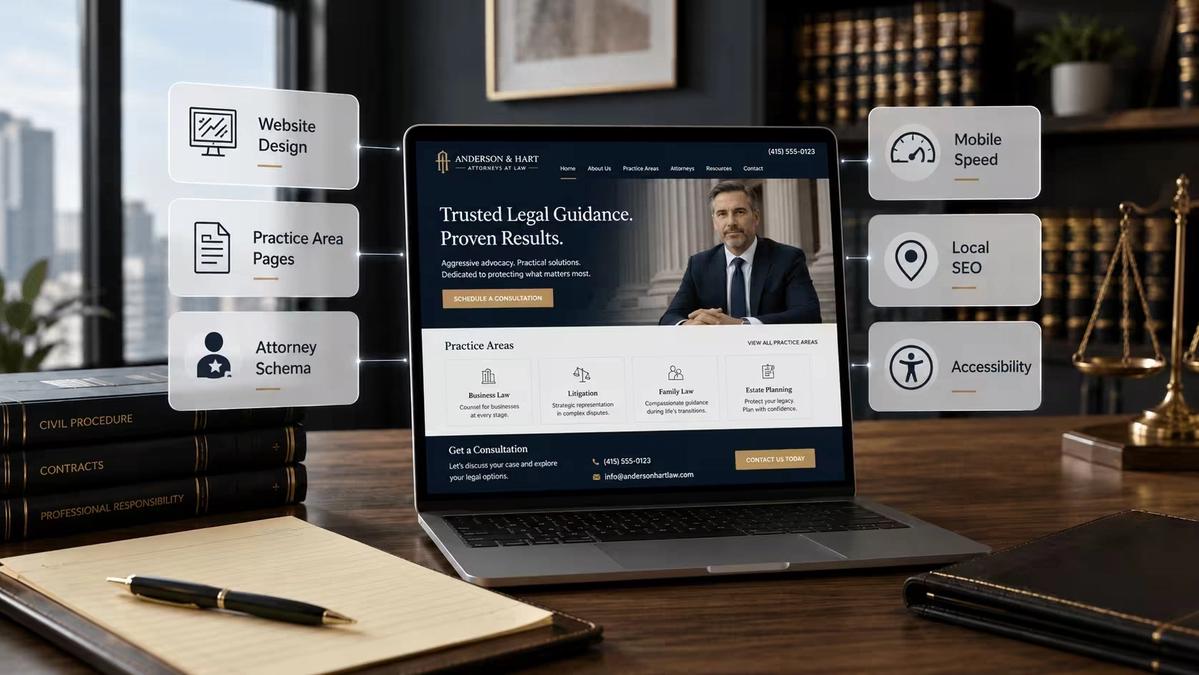
Most law firms don't have a web design problem. They have a web performance problem.
The site exists. It has the firm name, a list of practice areas, a phone number, and a contact form. It looks professional enough. But it doesn't rank for anything a potential client would actually search for, it loads slowly on mobile where most local legal searches happen, and it hasn't produced a single trackable new client inquiry since it launched.
That's not a design failure. It's a structural one, and it's what separates a law firm website that works from one that simply exists.
Why Most Law Firm Websites Don't Rank
The fundamental issue with most attorney websites is that they're built to look like a law firm, not to rank like one.
A law firm doesn't compete for "attorney." It competes for specific searches: "family law attorney Granbury TX," "estate planning lawyer Fort Worth," "criminal defense attorney Weatherford." Each of those is a different search term, with a different intent, in a different market. Ranking for any of them requires a dedicated page built around that specific term, with its own content, its own structured data, and its own local signals.
The typical law firm website has a homepage, an about page, a practice areas page, and a contact page. The practice areas page lists ten things the firm handles. That single page is competing for ten different searches simultaneously and winning none of them.
What actually ranks is specificity. One page per practice area. One page per city you serve. Content written around the exact language potential clients use when they're searching for help, not the language attorneys use when describing their own services.
What Law Firm Website Design Actually Requires
Practice Area Architecture
Every practice area your firm handles should have its own dedicated page. If you handle divorce, child custody, child support, property division, and adoption, those are five pages, not one "family law" page with five paragraphs.
Each practice area page needs content written around the specific search terms people use when they're in that situation. Someone facing a divorce in Hood County isn't searching "family law attorney." They're searching "divorce lawyer Granbury TX" or "how to file for divorce in Texas." The page that answers that search specifically is the one that ranks.
Location Pages
A law firm serving multiple cities needs dedicated content for each one. A Fort Worth estate planning attorney who also serves Granbury, Weatherford, and Cleburne needs pages that signal relevance for each market, not a footer that lists service areas.
This matters because local search is geographically specific. Ranking in Fort Worth doesn't automatically produce visibility in Granbury. Each market requires its own signals, its own content, and its own structured data.
Attorney Schema Markup
Schema markup is structured data embedded in the site's code that tells Google who you are and what you do. For law firms, properly implemented attorney schema includes the firm name, attorney names, bar admission, practice areas, geographic service area, and contact information, all in a machine-readable format Google can use to build rich search results.
Most law firm websites built on WordPress templates have no schema markup, partial implementations, or incorrect configurations. Google treats those sites as less authoritative for legal searches and ranks them accordingly.
Mobile Performance
The majority of local legal searches happen on phones. Someone who just received divorce papers, got arrested, or lost a family member isn't sitting at a desktop. They're searching on their phone, often under stress, and they will leave a slow site without a second thought.
Google measures this. Core Web Vitals are the performance metrics Google uses as a direct ranking signal, and they penalize slow mobile load times in search results. A law firm website that scores 55 on Google's Lighthouse performance audit is being penalized in rankings every day it stays live. A site that scores 95 or better is not.
The performance gap between a WordPress site built with a page builder and a custom-coded site on a modern framework is measurable and significant. Custom builds consistently score 95 or better. Page builder sites rarely do.
ADA Compliance
ADA web accessibility claims against businesses, including law firms, have increased substantially in recent years. A law firm website that fails basic accessibility standards isn't just a liability waiting to happen. It's also penalized in Google's accessibility audit, which affects overall search performance.
Proper accessibility implementation includes correct heading hierarchy, image alt text, keyboard navigation, sufficient color contrast, and screen reader compatibility. These are technical requirements, not design preferences, and they need to be built into the site from the start rather than retrofitted later.
Copy That Complies
Attorney advertising is governed by state bar ethics rules. In Texas, the State Bar Rules of Professional Conduct govern what can and cannot appear on a law firm website: what claims can be made, what disclaimers are required, and what constitutes a misleading statement about outcomes.
A developer who doesn't know these rules exist can inadvertently create compliance problems for the firm. In our process, all website copy is reviewed and approved by the attorney before anything goes live. The attorney is always the final authority on whether the content meets their bar's advertising requirements.
The Platforms Most Law Firm Sites Are Built On
The majority of law firm websites in the DFW area fall into one of three categories.
Legal marketing platform subscriptions. FindLaw, Justia, Martindale-Hubbell, and similar services offer attorney websites on subscription models. The sites are template-based, the SEO is generic, and the fundamental problem is ownership. If you stop paying, the site goes away. You're renting web presence, not building an asset.
WordPress with a legal theme. Most independent agencies and freelancers serving law firms build on WordPress with a premium legal theme. These sites look professional at launch and perform adequately for basic web presence. The problems are performance (page builders generate slow code), ongoing maintenance (WordPress requires constant updates that occasionally break things), and long-term cost (someone has to maintain it).
Custom-coded sites on modern frameworks. Built from scratch, no templates, no page builders. Faster load times, lower maintenance overhead, better search performance. Takes longer to build and costs more upfront. For a firm where the website is a meaningful client acquisition channel, the investment produces a different return than a template build.
The right choice depends on what you need the site to do. A solo attorney who needs basic web presence and a contact form has different requirements than a firm actively competing for local search rankings across multiple cities and practice areas.
What Competitive Law Firm Websites Look Like in the DFW Market
Fort Worth is a real legal market. Family law, criminal defense, personal injury, and estate planning practices are competing for the same pool of clients, and the firms that invested in their web presence two or three years ago are compounding that advantage every month.
The pattern in smaller markets is different. Most law firm websites in Granbury, Weatherford, and Cleburne were built quickly and haven't been meaningfully updated. The competition for specific search terms in Hood County and Parker County is thin enough that a well-built site with focused local SEO can establish page-one rankings relatively quickly and hold them.
That window is open now. As the DFW market continues to expand westward and more attorneys recognize the value of local search presence, it will close. Firms that move first in their specific markets have a meaningful advantage over those that wait.
What the Build Process Looks Like
Every law firm website we build starts with a conversation about what the firm actually needs the site to do: which practice areas, which cities, what kind of clients, what the existing site's problems are.
From there, the process covers discovery and architecture first, with keyword research for each practice area and service area mapped before a word of copy is written. Copy comes next, written around real search terms and reviewed by the attorney before anything goes live. Design and development follows, with every site custom-coded and scoring 95 or better on Google's Lighthouse audit across performance, accessibility, best practices, and SEO. Structured data is built in throughout: attorney schema, local business schema, and FAQ schema where appropriate. Launch includes sitemap submission, Search Console configuration, and initial indexing requests.
Every project is scoped individually. There are no packages. What you need depends on how many practice areas you handle, how many cities you serve, whether you need intake forms or scheduling integration, and how competitive your specific market is.
Starting Point
If you're not sure whether your current site is working for you, the fastest way to find out is to search Google for your primary practice area and your city. If you're not on page one, or not visible at all, the site isn't doing its job regardless of how it looks.
We offer a free audit covering page speed, local SEO fundamentals, and technical health. No pitch attached, just an honest look at where things stand and what it would take to fix them.
Or if you're ready to talk about a build: Get in touch →
We serve law offices in Granbury, Fort Worth, Weatherford, Cleburne, and across North Texas.