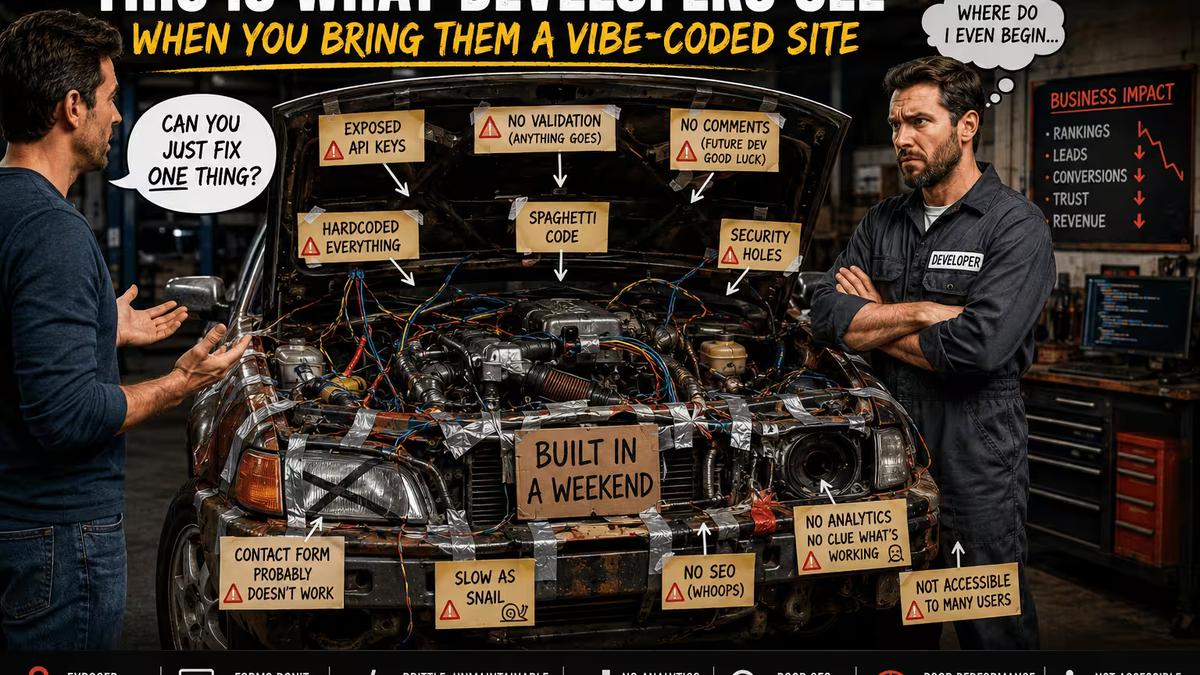
I get these requests regularly now. Someone built a website using an AI tool, or hired someone who did, and now something is wrong. Or they want to add something. Or they just want ongoing help keeping it up to date. They need a developer.
I pass on every single one of them. Not out of arrogance, and not because I have anything against AI. I use it every day. I pass because I know exactly what those sites are, what they are missing, and what it actually means to be handed one as a working developer. The term for it is AI code janitor, and it is not a role I am willing to fill.
Here is why.
Here Is How These Sites Get Built
Someone with a few weeks of curiosity and a ChatGPT subscription decides they can sell web design services. They open an AI tool, describe what they want, and iterate until something appears in the browser that looks like a business website. Two days later they call it done and send an invoice.
That is the whole process.
No discovery. No strategy. No review of what the code actually does. No consideration of what the business needs the site to accomplish. Just prompting until it looks close enough, then moving on to the next client. The documented workflow is: the AI produces code, it seems to work, the builder moves on. No code review. No security audit. No thought about whether the thing they just shipped actually serves the business that paid for it.
And here is the part that should concern you if you hired one of these people: they have no idea what they built. They genuinely do not know. The AI wrote the code. They watched it happen.
What They Did Not Think About
Let me be specific, because "they didn't know what they were doing" is easy to dismiss as professional snobbery. So here is what actually gets skipped. And this is not an exhaustive list. It is a representative one. Before the first page is designed, a professional has already thought about legal compliance, local SEO mechanics, hosting and infrastructure, content strategy, and a half dozen other categories that never come up in a vibe session because the person running it did not know they were supposed to ask.
Research into vibe-coded sites consistently finds leaky forms, brittle authentication, and broken SEO among the most common failures. One in five sites built on popular AI platforms is actively leaking credentials or API keys into the browser. Not hypothetically. Actually leaking them right now.
The contact form. Yes, there is one. Does it work? Does it actually deliver messages to your inbox, or does it silently fail and you never know? Does it validate input so garbage data does not pile up in your database? Does it block bots, or are you about to get buried in spam? These are not advanced questions. They are table stakes. They get skipped.
Structured data. JSON-LD tells Google what your business actually is, what your hours are, where you are located, what services you offer. It is how you show up correctly in search results. The problem with structured data on vibe-coded sites is not that the tools cannot support it. It is that the person building your site has no idea it exists or why it matters.
Conversion focus. A business website exists to get you customers. The layout, the copy, the calls to action, the flow from landing to contact, all of it should be built around that goal. A vibe-coded site is built around looking like a website. Those are not the same thing.
Semantic HTML. The structure of a web page is not just visual. Search engines and screen readers both depend on proper HTML elements to understand what a page is and what it contains. Headings that follow a logical hierarchy. Nav elements that identify navigation. Main, article, section, used correctly and intentionally. A vibe-coded site is typically built with div elements stacked inside div elements, which looks fine in a browser and means nothing to Google or to a user relying on assistive technology. It hurts SEO and accessibility at the same time, invisibly, from the moment the site goes live.
Accessibility. Not "it loads in the browser so people can use it." Actual accessibility. Proper contrast ratios. Keyboard navigation. Screen reader compatibility. Alt text that means something. Over 94% of homepages tested in a 2025 accessibility audit still contain detectable failures. Vibe-coded sites are not beating that average.
Tracking. You want to know where your leads come from. You want GA4. Maybe a Meta pixel. Maybe conversion tracking tied to your contact form so you can see which marketing is working. "Claude, add a tracking pixel" is not a tracking strategy. Someone has to know what they are setting up, why, and whether it is actually firing correctly.
Integrations. You mention you want appointment booking. The vibe coder drops a Calendly embed on the page and calls it done. That is not an integration. A real integration means both ends are connected and talking to each other. Does the booking sync with your calendar? Does a confirmed appointment trigger a confirmation email to the customer? Does it notify the right person on your end? Does it feed into your CRM so you have a record of every lead? Is there a follow-up sequence attached? A professional thinks through both ends before touching the code. The vibe coder has no idea there is another end.
Performance. Search engines rank fast sites higher. Users abandon slow ones. A vibe-coded site probably has unoptimized images, render-blocking scripts, and a Lighthouse score that would embarrass a professional. But it loads, so the builder called it done.
What "Looks Fine" Is Actually Costing You
A plumbing business owner built his own site using an AI tool on a Sunday afternoon. The site looked fine on his laptop. On mobile, the contact form sat half off-screen, the click-to-call button did not work, and the page took nine seconds to load. He had only ever checked it on his home computer.
For fourteen months he assumed business was just slow.
It was only when a friend pointed out the mobile issues that he realized what had been happening. By then his Google rankings had dropped significantly. A slow, broken mobile experience is one of the clearest signals Google uses to push a site down in the results.
That is not a horror story. That is a typical outcome.
The Business Owner Gets Left Holding It
The person who built your site has already moved on. They are prompting out another one for another client right now. They were never invested in your business outcomes. They were invested in producing something that looked finished.
You are now the owner of a codebase nobody understands, including the person who made it. When something breaks, and it will, you will hire someone to fix it. That someone will open the code, realize what they are looking at, and have a very honest conversation with you about what it would cost to make it right.
That conversation is usually more expensive than building it correctly the first time.
What a Professional Engagement Actually Looks Like
Before a professional writes a line of code, they have already done work that cannot be prompted out of an AI tool. Who is searching for your business and what exact words are they using? What does your competitor's site do better than yours? What does a buyer in your market actually need to see before they pick up the phone? That research shapes everything: the structure of the site, the language on the page, the order information appears, and where the calls to action go. You cannot vibe your way to any of those answers. They require real inquiry into a specific market, a specific customer, and a specific business.
A professional builds a contact form that works and can prove it. They know what JSON-LD is and why it matters for your specific business type. They think about page speed before launch, not after. They set up analytics that actually tell you something useful. They make sure the site is accessible to the people you are trying to reach. And when something needs to change six months from now, they can open the code and make that change without breaking three other things, because they understood what they built in the first place.
What I Will Do Instead
If you have a vibe-coded site, there is one conversation I am willing to have: treating it as a prototype and building something real on top of the foundation it gave you.
The visual direction might be worth keeping. The content might be a good starting point. But the code gets rebuilt with professional judgment behind it, proper architecture, real integrations, and a codebase that someone can actually maintain. That is a different engagement than fixing what is broken, and it is the only one that actually solves the problem.
I am not an AI code janitor. But I am happy to build you a website that works.