It's the first question almost every Granbury business owner asks -- and one of the hardest to get a straight answer on. Search "website cost" and you'll find national articles throwing out ranges so wide they're basically useless. "$500 to $50,000" doesn't help you budget for anything.
This article gives you the Granbury-specific answer. What different types of websites actually cost, what drives the price up or down, and what questions to ask before you hire anyone.
Why Website Pricing Is So Hard to Pin Down
The honest answer is that "website" describes too many different things. A one-page site for a solo contractor and a multi-location service business with online booking, a client portal, and custom integrations are both "websites" -- but they're about as comparable as a pickup truck and a freight trailer.
Price is determined by a handful of variables: who builds it, what platform it runs on, how much content needs to be written, how many pages you need, and what custom functionality is required. Change any one of those and the number changes significantly.
What makes this harder in a market like Granbury is that you're getting quotes from a mix of sources -- national outfits like Hibu and Scorpion that operate here, freelancers on Fiverr and Upwork, local marketing shops, and independent developers. They're not building the same thing, they're not charging on the same basis, and they're not measuring success the same way. Comparing their quotes directly is like comparing a fast food meal to a sit-down restaurant based on price alone.
The Main Pricing Tiers
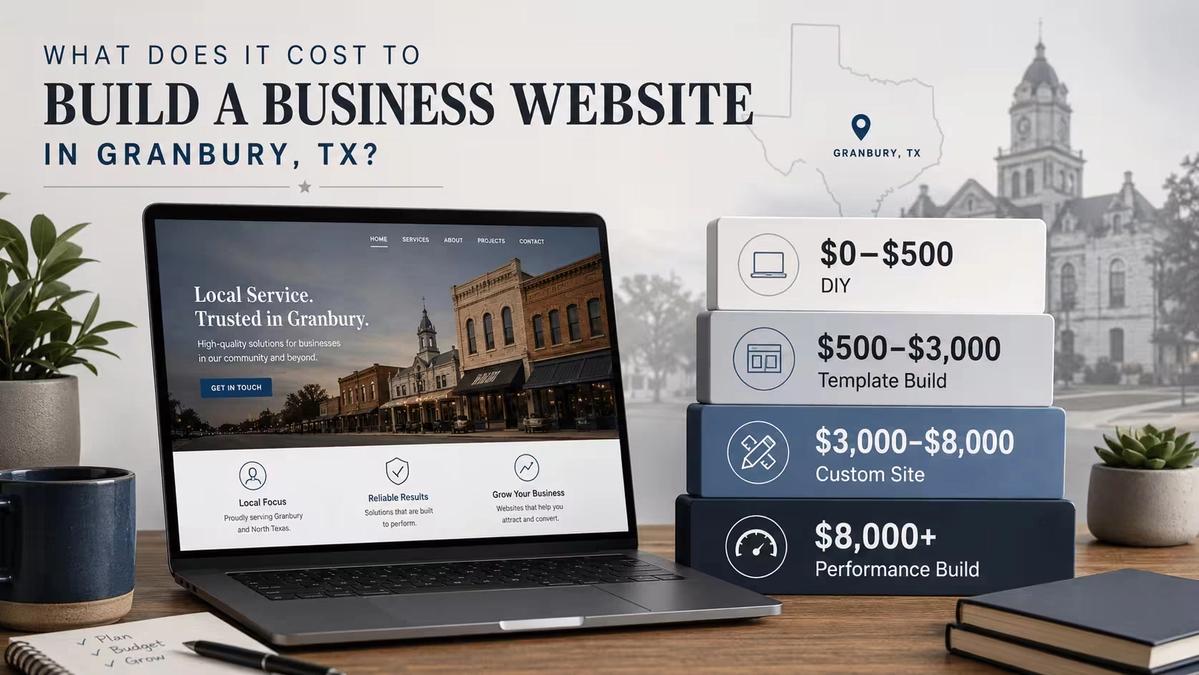
$0 -- $500: DIY and AI Builders
Wix, Squarespace, GoDaddy Airo, and similar platforms will get you something live for close to nothing. If you're a sole proprietor who needs a basic web presence and you have time to figure out the tools yourself, this tier exists and it works for very limited use cases.
The catch is what you don't get. These platforms produce generic sites that load slowly on mobile, have no real local SEO infrastructure, and lock you into a proprietary ecosystem you don't own. They're fine for a portfolio or a hobby. For a Hood County business trying to rank on Google and win customers, they're typically a starting point that eventually gets rebuilt rather than a long-term solution.
There's also the time cost. "Free" website builders aren't free when you factor in the hours spent learning the platform, writing the copy, and troubleshooting why nothing looks the way the demo suggested it would.
$500 -- $3,000: Budget Freelancers and Template Builds
This is the most crowded part of the market and the one where expectations most frequently don't match reality. At this price point you're typically getting a WordPress site built with a page builder like Elementor or Divi, populated with a purchased theme, and handed off without much strategic thought about performance or SEO.
These sites look professional enough on the surface. The problems tend to show up later: slow load times that hurt both rankings and user experience, difficulty making updates without breaking something, and ongoing maintenance costs that add up fast. WordPress requires regular updates to core, themes, and plugins -- skip them and you're exposed to security vulnerabilities; do them and you risk breaking something on your site.
For some businesses in Granbury this tier is appropriate. A very simple site with a few static pages and no SEO ambitions can be built and maintained at this price point without major issues. If you're expecting it to rank on Google and drive customers, you'll likely be disappointed.
$3,000 -- $8,000: Mid-Range Custom and Semi-Custom Builds
This is where you start getting real strategic work alongside the technical build. A developer at this price point should be doing keyword research before writing copy, building proper local schema markup, setting up a sitemap and canonical structure, and delivering a site that scores well on Google's Core Web Vitals audit.
At the lower end of this range you may still be getting a WordPress build, but from a developer who knows what they're doing with it -- proper theme architecture, optimized image handling, caching, and a sensible plugin stack rather than whatever the developer grabbed first.
At the higher end you're more likely getting a custom build on a modern framework, which typically means better performance, less maintenance overhead, and a cleaner codebase that's easier to work with long-term.
For most Granbury small businesses -- a contractor, a dental practice, a law office, a service company with 5-50 employees -- this is the range where you get a site that actually performs.
$8,000 and up: Serious Custom Builds
Custom-coded websites built from scratch, with no templates, no page builders, and no shortcuts. Every decision -- from the framework to the component architecture to the image optimization pipeline -- is made deliberately with performance and maintainability in mind.
Sites at this level consistently score 95 or better across all four categories of Google's Lighthouse audit: performance, accessibility, best practices, and SEO. That's not a marketing claim -- it's a measurable outcome you can verify yourself before you pay.
This tier is appropriate for businesses where the website is a primary revenue channel -- a company running significant paid advertising where landing page quality directly affects cost per lead, a service business competing in a saturated market where page-one ranking is the difference between thriving and struggling, or any business that's been burned by a cheap build and understands what the right infrastructure is worth.
For Granbury businesses competing against Fort Worth companies targeting Hood County customers online, this is often where the conversation starts.
What Actually Drives the Price Up
Understanding what moves the number helps you evaluate quotes more intelligently.
Copywriting. Writing good web copy takes real time. If a developer is charging $2,000 for a five-page site and including copywriting in that number, either the copy is going to be thin or the developer is losing money on the project. Some developers write copy themselves; others bring in a specialist. Either way, copy that's written around real search terms and real customer intent -- rather than generic filler -- is one of the most important factors in whether the site produces results.
Custom functionality. Online booking, customer portals, e-commerce, custom calculators, API integrations -- any of these add significant development time and therefore cost. A simple brochure site has none of these. A service business with complex scheduling needs or multiple service categories has several.
Number of pages. More pages means more content, more design work, and more development time. A five-page site and a twenty-page site are not the same project even if the per-page design looks similar.
Photography and media. Stock photography is cheap and looks like stock photography. Custom photography for a Granbury business -- real photos of your team, your shop, your work -- is a separate cost that's worth budgeting for. Clients recognize the difference even when they can't articulate it.
SEO depth. Basic SEO (meta tags, clean URLs, a sitemap) takes an hour. Serious local SEO for a Granbury business -- keyword research, location-specific copy, schema markup, Google Business Profile optimization, ongoing monitoring -- is a different scope entirely. Make sure you understand what any quote includes on this front.
The Ongoing Cost Question
The upfront build price is only part of the picture. Websites have ongoing costs regardless of who builds them or what platform they run on.
Hosting ranges from a few dollars a month for shared hosting to $20-50 a month for managed hosting that includes performance optimization and security monitoring. For a custom build on a modern platform like Vercel, hosting is often free or near-free at the traffic levels most Granbury small businesses operate at.
Domain registration runs $15-20 a year for a standard .com through most registrars.
Maintenance is where costs vary most. WordPress sites need ongoing updates and occasional troubleshooting -- budget $50-200 a month if you're paying someone to handle this, or accept the risk of doing it yourself. Custom-built sites on modern frameworks have dramatically lower maintenance overhead because there's no plugin ecosystem to keep updated and no legacy code accumulating technical debt.
Content updates. If you need to add new services, update pricing, or add case studies, someone has to do that. Either you have CMS access and do it yourself, or you pay a developer for the time. Understanding this arrangement before you sign anything is important.
Questions to Ask Before You Hire Anyone
Regardless of budget, these questions will tell you a lot about who you're dealing with:
What platform will the site be built on, and why? A developer who can't explain the reasoning behind their platform choice is probably just building what they always build.
What will my Lighthouse score be at launch? Ask for a specific number. If they don't know what Lighthouse is, that tells you something.
What does local SEO look like in this project? Basic meta tags are table stakes. Schema markup, keyword research, and location-specific copy are what actually move rankings.
Who writes the copy? If it's AI-generated filler, that's worth knowing upfront.
What does the ongoing relationship look like? Who do you call when something breaks? What does maintenance cost?
Can I see examples of sites you've built, with their Lighthouse scores? Actual performance numbers are verifiable. Anyone can claim their sites are fast.
What This Looks Like for a Granbury Business Specifically
Hood County is a small market with real competition. Fort Worth companies are actively targeting Parker and Hood County customers through local SEO, and businesses in Granbury, Acton, and Tolar are losing those customers to competitors they've never heard of because their websites aren't competitive online.
In that environment, a $1,500 WordPress site isn't just a cost -- it's an opportunity cost. Every month that passes without ranking for the searches that matter is revenue going somewhere else.
The businesses in Granbury that are starting to win online are the ones that treated the website as infrastructure rather than a checkbox. A custom build with a 95+ Lighthouse score, proper local schema, and copy written around what Hood County customers actually search for is a different asset than a template site with the city name dropped into the headline.
The price difference between those two outcomes is real. So is the difference in what they produce.
If you want to know where your current site stands -- or get an honest assessment of what a new build would cost for your specific situation -- we offer a free audit with no pitch attached.
We build custom websites for businesses in Granbury, Weatherford, Fort Worth, and across North Texas.