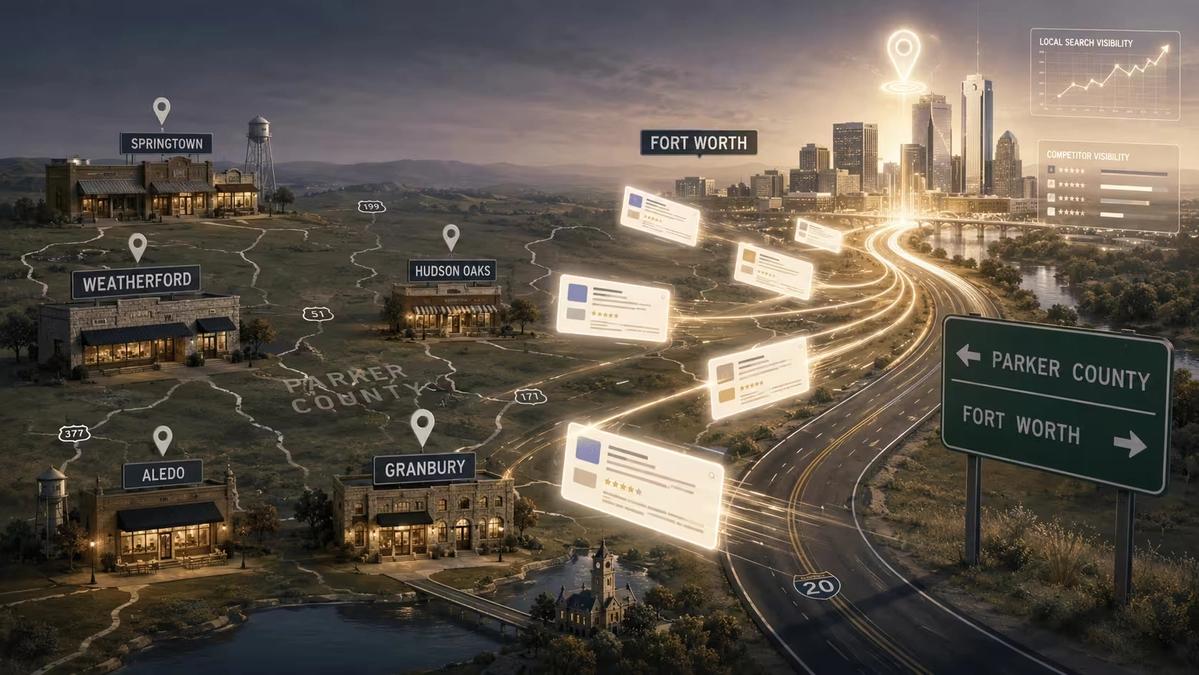
If you run a business in Weatherford, Aledo, Granbury, or anywhere else in Parker County, there's a good chance you've noticed something frustrating: when you search for what you do on Google, Fort Worth businesses keep showing up above you. Sometimes they're 30 miles away. Sometimes more.
It doesn't make sense on the surface. You're local. They're not. Your customers are here. So why is Google sending those customers somewhere else?
The answer isn't complicated, but it does require understanding how local search actually works -- and why the websites most Parker County businesses are running are structurally built to lose.
Google Doesn't Know What "Local" Means Without Being Told
This is the foundational issue. Google doesn't look at your business address and automatically decide you should outrank competitors who are farther away. It looks at signals -- technical signals, content signals, and authority signals -- and ranks pages based on how well those signals match what someone searched for.
A Fort Worth roofing company with a well-optimized website, properly structured local schema markup, and a handful of inbound links will rank above a Weatherford roofing company whose site has none of those things -- even if the Fort Worth company is 40 miles from the customer doing the searching.
This is what "winning local search" actually means. It's not about proximity. It's about which site Google trusts more to answer the query.
Most Parker County small businesses are running sites that give Google very little to work with.
What the Typical Parker County Business Website Looks Like
Walk through enough small business websites in Weatherford, Springtown, or Hudson Oaks and a pattern emerges quickly.
The site was built three to five years ago, usually on WordPress, by a local agency or a national outfit like Hibu that operates in this market. It has a home page, a services page, a contact page, and maybe a gallery. The copy is generic -- variations of "serving Parker County and surrounding areas" without any specificity about what that means. There's no structured data telling Google what type of business this is, where it operates, or what services it offers in machine-readable format. The site loads slowly on mobile because nobody optimized the images or eliminated the render-blocking scripts that WordPress page builders generate by default.
It ranks for the business name when you search for it directly. It ranks for almost nothing else.
Meanwhile, a Fort Worth competitor with a faster site, better-structured copy, and schema markup that explicitly defines their service area -- which they've set to include Weatherford and Parker County -- is showing up for searches that should belong to local businesses.
The Three Gaps That Keep Parker County Sites From Ranking
1. No Local Schema Markup
Schema markup is structured data embedded in your site's code that tells search engines, in explicit terms, what your business is and where it operates. A properly implemented LocalBusiness or ProfessionalService schema block tells Google your business name, phone number, address, service area, and what you do -- in a format it can parse reliably without having to infer it from your page copy.
Most WordPress sites built for small businesses in Parker County have no schema markup at all. Some have partial implementations that are incomplete or incorrect. Google treats those sites as less authoritative for local queries, which pushes them down in favor of sites where the data is present and clean.
A Fort Worth business that has explicitly defined Weatherford and Parker County in its areaServed schema field will often outrank a Weatherford business that has no schema at all -- even for searches happening in Weatherford.
2. Slow Load Times on Mobile
Google uses Core Web Vitals as a ranking signal. Largest Contentful Paint, Cumulative Layout Shift, Interaction to Next Paint -- these measure how fast and stable your site feels to a real visitor on a real device. Sites that score poorly on these metrics are penalized in rankings relative to sites that don't.
WordPress sites built with page builders -- Elementor, Divi, WPBakery -- almost universally score poorly on Core Web Vitals. They generate bloated code, load unnecessary scripts, and render slowly on mobile connections. In a market like Parker County where a significant portion of local searches happen on phones, that's a direct ranking disadvantage.
Custom-built sites on modern frameworks -- built with performance as a requirement from the start rather than an afterthought -- consistently score 95 or better on Google's Lighthouse audit. That gap between a 55 and a 97 on PageSpeed Insights isn't just a technical detail. It's a ranking factor that compounds over time.
3. Copy That Doesn't Match How People Search
"Serving the greater DFW area" is not a search term anyone types. Neither is "quality service for all your needs."
Local search ranking requires copy that matches the actual language people use when they're looking for what you do. A plumber in Weatherford needs copy that addresses "plumber Weatherford TX," "emergency plumber Parker County," and "water heater replacement Weatherford" -- not generic service descriptions that could apply to any plumber anywhere.
The Fort Worth businesses winning Parker County searches have often done this work deliberately. They've written location-specific pages and service-specific copy that maps to real search queries. Parker County businesses running generic copy built around what the agency thought sounded professional are invisible to those same searches.
The Compounding Problem
Here's what makes this hard to reverse quickly: search authority builds over time. A Fort Worth competitor that got its website right two years ago has been accumulating ranking signals -- crawl history, indexed pages, implicit signals from click behavior -- for two years. That's not easy to overcome in a month.
But it's also not permanent. Google rewards relevance and quality consistently. A Parker County business that fixes the technical gaps, rewrites its copy around real search terms, and builds proper local schema markup will start recovering position over time. The sites that don't make those changes will keep sliding as the competition keeps investing.
The window where Parker County businesses can compete in local search without a serious web presence is closing. The market is growing -- Parker County's population has increased over 20 percent since 2020 -- and that growth is attracting more competitors, including Fort Worth businesses actively expanding their geographic targeting westward.
What Fixing It Actually Requires
This isn't a problem you solve by refreshing your homepage design or updating your logo. The gaps are structural.
Technical: The site needs to load fast on mobile, score 95 or better on Core Web Vitals, and be built on a stack that doesn't accumulate technical debt every time WordPress releases an update.
Structured data: A properly implemented LocalBusiness schema block with accurate service area definition, business type, contact information, and location data.
Copy: Service-specific, location-specific copy written around real search terms -- not generic descriptions written to sound professional to a human reader without regard for how search engines parse intent.
Internal architecture: Pages structured so that Google understands the relationship between your services, your location, and the areas you serve.
None of this requires a massive budget. It requires building the site correctly from the start -- or doing a rebuild that addresses the structural issues rather than painting over them.
A Note on Parker County Specifically
Parker County has a particular dynamic worth understanding. Weatherford is the county seat and the commercial hub, but significant business activity runs through Aledo, Willow Park, Hudson Oaks, and Springtown as well. Businesses serving that whole area need web presence that signals geographic relevance across the county -- not just in Weatherford proper.
At the same time, Parker County sits directly adjacent to Tarrant County, which means Fort Worth competitors have natural geographic overlap to exploit. A roofing company, HVAC contractor, or law office in Fort Worth can legitimately claim to serve Parker County -- and if their site is better optimized, they'll rank there ahead of local businesses.
That's the competitive reality. The response isn't to out-spend Fort Worth agencies on marketing. It's to build a site that gives Google no reason to prefer a competitor 30 miles away over a business that's actually here.
We build custom websites for Parker County small businesses in Weatherford, Aledo, Granbury, and across the surrounding area. If your site isn't ranking for the searches that matter to your business, we offer a free audit that shows you exactly where the gaps are.
We also work with businesses in Fort Worth, Weatherford, and Granbury.