If you've gotten more than one quote for a website recently, you've probably noticed something: the prices vary wildly and nobody explains why. One developer wants $1,500. Another wants $8,000. Both say they'll build you a professional website.
The difference, most of the time, is WordPress.
This article breaks down what that difference actually means for a Granbury small business -- not in technical terms, but in the terms that matter: how fast your site loads, whether it shows up on Google, how much it costs to maintain, and what happens when something breaks.
What WordPress Actually Is
WordPress started as a blogging platform in 2003 and grew into the most widely used content management system in the world. Roughly 40 percent of all websites run on it. That market share is both its biggest selling point and the source of most of its problems.
When a developer builds a WordPress site, they're typically starting with a purchased theme -- a pre-built design template -- and customizing it using a page builder like Elementor, Divi, or WPBakery. They add plugins for contact forms, SEO, caching, security, and anything else the site needs. The whole thing runs on a server that requires regular updates to WordPress core, the theme, and every plugin installed.
This approach is fast to produce. A developer who knows WordPress well can have a decent-looking site live in a few days. That speed is why it dominates the market and why it's the default choice for agencies and freelancers working at lower price points.
The problems aren't visible at launch. They show up over time.
The WordPress Problems That Show Up Later
Performance
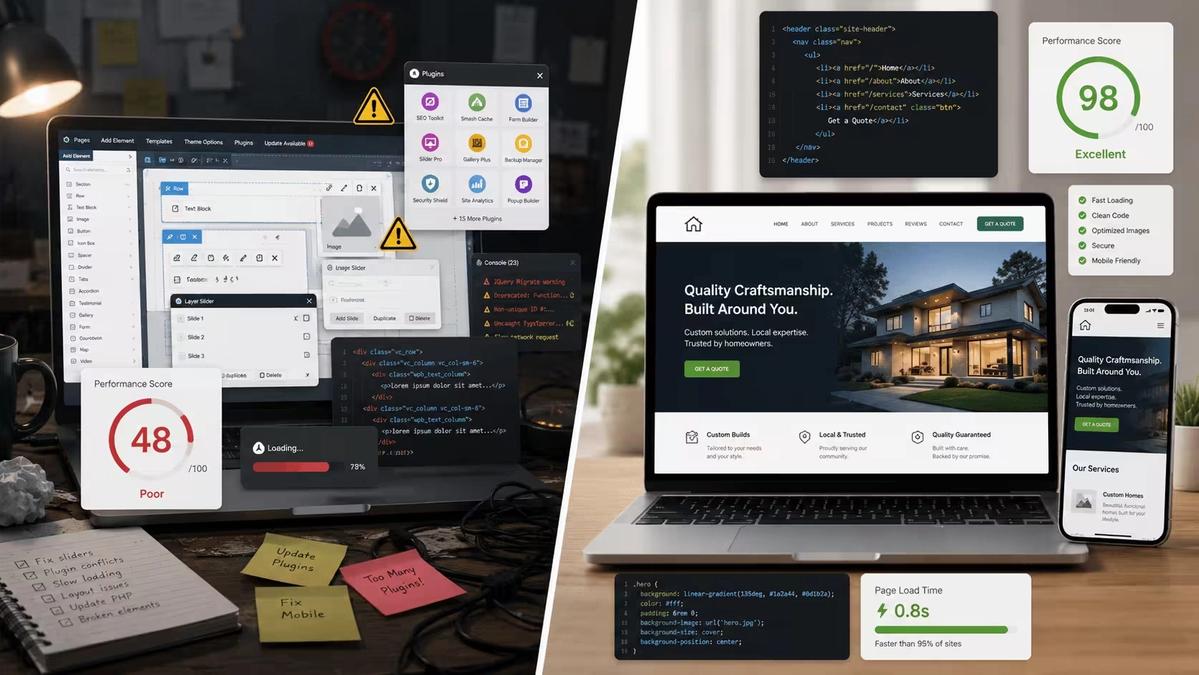
WordPress sites built with page builders carry significant code overhead. Page builders generate bloated HTML and load multiple CSS and JavaScript files that the browser has to process before your page appears. On a fast desktop connection this is barely noticeable. On a mobile connection -- where most local searches happen -- it's the difference between a site that loads in under two seconds and one that takes four or five.
Google measures this. Core Web Vitals -- the performance metrics Google uses as a ranking signal -- penalize slow sites in search results. A WordPress site built with Elementor on shared hosting routinely scores in the 40s and 50s on Google's Lighthouse audit. A custom-built site on a modern framework routinely scores 95 or better. That gap is a ranking disadvantage built into the foundation of your site before a single word of copy is written.
For a Granbury business competing against Fort Worth companies targeting Hood County customers, starting with a 40-point performance handicap is a problem that compounds every month.
Security
WordPress's market share makes it the most targeted platform for hackers on the internet. The plugin ecosystem -- which is what makes WordPress flexible -- is also its biggest security liability. Every plugin is a potential entry point. Outdated plugins with known vulnerabilities are one of the most common causes of WordPress sites getting hacked, redirected to spam pages, or used to send phishing emails.
Keeping a WordPress site secure means staying current with updates to core, themes, and every installed plugin. Skip an update and you're exposed. Run the update and occasionally something breaks. This is the maintenance treadmill that WordPress site owners either pay someone to manage or quietly ignore until something goes wrong.
Custom-built sites don't have a plugin ecosystem to maintain. The attack surface is smaller and the dependencies are chosen deliberately rather than accumulated over time.
Ongoing Costs
A WordPress site isn't a one-time purchase. The hosting, the premium theme license, the premium plugin licenses, and the maintenance either cost money monthly or cost your time. Budget-tier WordPress hosting -- where most cheap builds end up -- introduces its own performance problems on top of the ones already baked into the page builder.
If you pay a developer or agency for ongoing WordPress maintenance, you're typically looking at $50-200 a month for someone to run updates and fix what breaks. That's $600-2,400 a year on top of the initial build cost, indefinitely, for a site that was cheap to build partly because those ongoing costs weren't factored into the original quote.
The Update Problem
WordPress releases regular updates. So does every theme and every plugin. These updates don't always play nicely with each other. A plugin update that conflicts with your theme can break your layout, disable your contact form, or take down your site entirely. This happens to real businesses regularly and it's one of the most common reasons Hood County business owners end up rebuilding a site they thought was finished.
What a Custom Build Actually Means
A custom-built website is coded from scratch on a modern framework -- no purchased themes, no page builders, no plugin ecosystem. Every component is written specifically for that site, which means there's no bloat from features the template includes that you don't use, no conflicting dependencies, and no maintenance treadmill of updates that break things.
The performance difference is measurable and significant. Custom-built sites consistently score 95 or better across all four categories of Google's Lighthouse audit: performance, accessibility, best practices, and SEO. That's not because custom developers are smarter than WordPress developers -- it's because the underlying architecture doesn't carry the overhead that WordPress page builders generate by default.
For a Granbury business, that performance gap matters in two specific ways. First, Google uses Core Web Vitals as a ranking signal -- a faster site ranks better, all else being equal. Second, visitors on mobile connections notice load time. A site that loads in 1.2 seconds converts differently than one that loads in 4 seconds, and most local search traffic arrives on a phone.
Beyond performance, a custom build means you're not dependent on a third-party plugin for basic functionality. Your contact form, your CMS, your analytics integration -- all of it is built to work together rather than assembled from parts that may or may not stay compatible over time.
When WordPress Is the Right Choice
WordPress isn't always wrong. There are situations where it's a reasonable fit:
If your budget is genuinely under $3,000 and you understand the performance and maintenance tradeoffs, a well-built WordPress site from a competent developer is better than no site. A developer who knows what they're doing with WordPress -- using a lightweight theme, minimizing plugins, configuring caching properly -- can produce a site that performs reasonably well even if it won't match a custom build.
If you need a very specific plugin that has no custom equivalent -- a particular booking system, a specialized e-commerce integration, a niche industry tool -- WordPress's plugin ecosystem is genuinely useful. Sometimes the right tool for the job already exists and rebuilding it from scratch doesn't make sense.
If you already have a WordPress site that performs reasonably well and your primary need is content updates, staying on WordPress and investing in content is often more sensible than a full rebuild.
The honest answer is that most Granbury small businesses don't fall into any of these categories. Most have a WordPress site that was built cheaply, performs poorly, and hasn't been updated in years. For those businesses the question isn't WordPress vs custom -- it's whether to fix what exists or rebuild it correctly.
The Question Worth Asking
Before you hire anyone to build or rebuild your website, ask them one question: what will my Lighthouse score be at launch?
A Lighthouse score is a measurable, verifiable number that Google's own tool produces. It tests performance, accessibility, best practices, and SEO on a scale of 0 to 100. You can run it yourself on any site at any time using Google's PageSpeed Insights tool -- paste in any URL and see the scores in under a minute.
A developer who commits to 95 or better across all four categories is building to a standard you can hold them to. A developer who doesn't know what Lighthouse is, or who hedges on the number, is probably building on WordPress with a page builder and hoping you won't check.
That question costs nothing to ask and tells you almost everything you need to know about who you're dealing with.
What This Means for Hood County Businesses Specifically
Granbury and the surrounding Hood County area is a market where most small business websites were built the same way -- WordPress, page builder, shared hosting, minimal SEO. The bar is low enough that a well-built custom site stands out considerably in local search.
Fort Worth companies that are targeting Hood County customers online have often already invested in faster, better-structured sites. The businesses in Granbury, Acton, and Tolar that are losing local search rankings to outside competitors are almost always losing them to sites with better technical foundations -- not better products or better pricing.
A custom build with a 95+ Lighthouse score, proper local schema markup, and copy written for the Hood County market is a different competitive position than a WordPress site with a 50-point performance score. The price difference between those two outcomes is real. So is the difference in what they produce over time.
If you want to know where your current site stands, run it through Google's PageSpeed Insights at pagespeed.web.dev and look at the mobile score. If it's below 70 on performance, the site is working against you in search rankings every day it stays live.
We offer a free audit that goes deeper -- page speed, local SEO fundamentals, and technical health -- with no pitch attached.
We build custom websites for businesses in Granbury, Weatherford, Fort Worth, and across North Texas.