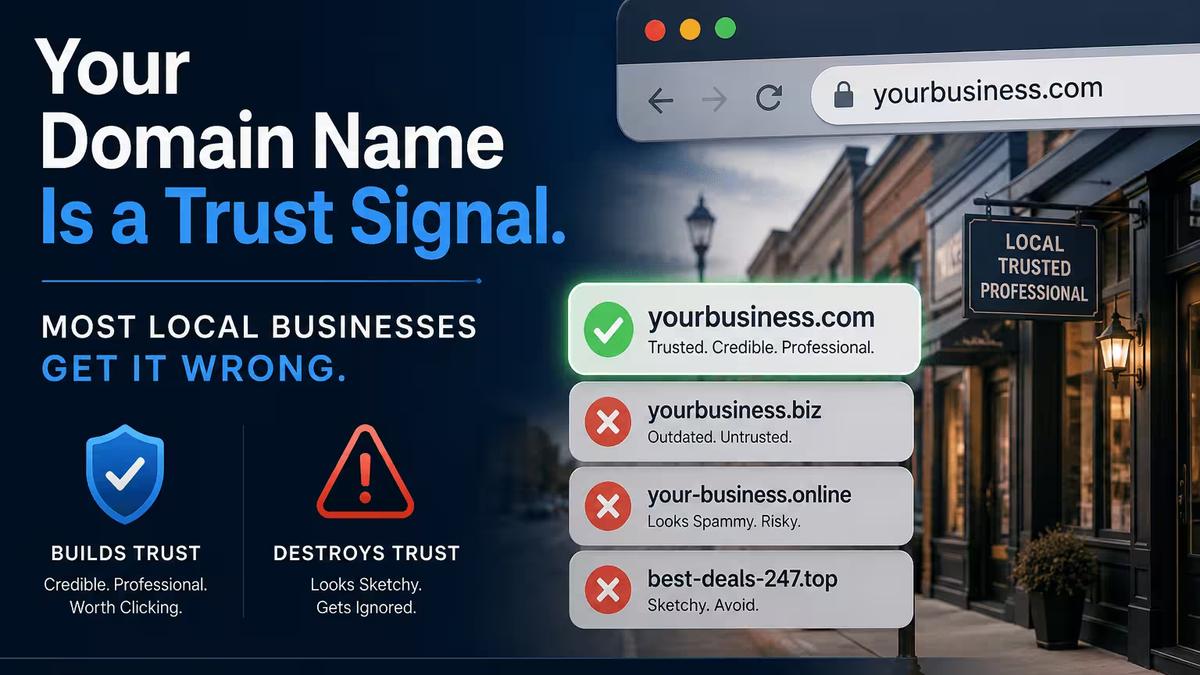
Most local businesses pick a domain name in about five minutes. The .com they wanted was taken, so they grabbed a hyphenated version, added their city name, or settled for .biz. Done. Move on.
What nobody told them is that this five-minute decision has consequences that play out for years — in search rankings, in email deliverability, in whether a stranger seeing their URL for the first time decides to click or scroll past. Your domain is not just a web address. It is the first signal a potential customer receives about whether your business is worth trusting.
This article breaks down exactly what those consequences are, why they happen, and what you can do about it.
Why Domain Names Carry Trust Signals
When someone finds your business through Google, your domain name appears in the search result before they ever see your site. When you send an estimate or a follow-up email, your domain is right there in the "from" address. When someone types a URL they heard from a friend, they are relying on what they remember about how it looked and sounded.
At every one of these touchpoints, your domain is doing one of two things: building confidence or creating friction. There is no neutral. A domain that reads as professional and trustworthy removes a barrier. A domain that reads as cheap, unfamiliar, or sketchy adds one — and many potential customers will not bother clearing it.
The signals fall into two categories: technical signals that affect how systems treat your domain, and psychological signals that affect how people respond to it. Both cost you business.
The Technical Trust Layer
TLD Reputation and What It Does to Your Email
Your top-level domain — the .com, .net, .biz, or whatever follows your business name — has a reputation that exists independent of your business. That reputation is built over years of aggregate behavior by everyone who has ever registered a domain on that extension.
Some TLDs have been systematically exploited by spammers and malware distributors. .biz, .info, .click, .loan, and several others have abuse rates that are measurably higher than .com. Spamhaus, one of the most widely used blocklist operators on the internet, publishes ongoing data on TLD abuse rates. Email filtering systems at Gmail, Outlook, and other major providers have internalized this data. They do not evaluate your domain in isolation. They evaluate it in the context of the TLD it sits on.
If your business operates from a .biz domain and uses it for email, a meaningful percentage of the legitimate emails you send — estimates, invoices, follow-ups, appointment confirmations — are scoring higher on spam filters before the recipient ever sees them. Some get caught entirely. Most just land with reduced deliverability confidence. The prospect who asked for a quote yesterday and never responded might have simply never gotten your reply.
This is not theoretical. Inbox placement rates are measurably lower for domains on high-abuse TLDs. The fix is not complicated: a clean .com domain, properly configured with SPF, DKIM, and DMARC records, combined with business email through Google Workspace or Microsoft 365. But you have to know the problem exists before you can solve it.
Domain History and What It Imports Into Your Business
Expired domains are bought and resold constantly. A domain that looks freshly available might have ten years of history attached to it — history you are inheriting whether you know it or not.
A domain previously used for a payday loan aggregator, a link farm, or adult content carries that backlink profile into your new business context. Google's algorithms evaluate your domain's historical associations as part of how they assess trust and authority. A business that purchases an expired domain because it was cheap or because it already had some "domain authority" may be importing a penalty that suppresses their rankings from day one.
Before registering any domain that is not a fresh registration, check three things. Run it through the Wayback Machine (web.archive.org) to see what the domain previously hosted. Pull the backlink profile through a tool like Ahrefs or Majestic to evaluate what sites have historically linked to it. Run a Google search for site:yourdomain.com to see if it is indexed and how. If anything looks problematic, walk away. The few dollars you saved are not worth carrying someone else's history.
Local SEO and the Domain Signals Google Reads
Local SEO is not a separate system from the rest of search. It runs on the same trust infrastructure. Your Google Business Profile is tied to your website domain. Your citations across directories reference your domain. Your website itself sends signals — including signals about your domain's age, history, and TLD — that factor into how Google evaluates your authority in local results.
A domain with a clean history on a trusted TLD, consistently applied across your website, your GBP listing, and your directory citations, builds trust incrementally over time. A domain with a messy history, or one that does not match your business name on your GBP, introduces inconsistency that Google has to resolve. Inconsistency costs you.
Exact-match domains — the practice of registering granburyroofer.com or fortworththplumber.com to get the keyword in the domain — used to work as a ranking tactic. Google devalued it years ago. Today, an exact-match domain does not outrank a trusted brand with a clean domain just because it contains the keyword. What it does do is make your business look like a directory listing or a lead-gen site, not an established local operation. That perception has its own costs.
The Psychological Trust Layer
Why Your Gut Reaction to a Sketchy URL Is Correct
When you see a .biz domain and feel a flicker of distrust before you click, that reaction is not irrational. It is Bayesian. Your brain has processed thousands of URLs over years of internet use and has built a prior probability about what kinds of domains are associated with legitimate businesses versus spam, scams, and low-quality operations.
Your potential customers have built the same prior. They may not be able to articulate it. They probably cannot tell you that .biz has a higher spam rate than .com. But they feel it — and they act on it.
Research from Stanford's Web Credibility Project established that URL structure is among the cues users rely on to assess site legitimacy before they ever arrive on the page. The domain name in a search result, in an email, or in a link shared in a text message is a trust signal that precedes everything else you have done to present your business professionally.
The patterns that trigger distrust are consistent:
Hyphenated domains. One hyphen raises eyebrows. Two hyphens read as spam. best-cheap-granite-countertops-dallas.com is the kind of domain a keyword-stuffing operation from 2009 would have registered. Even if your business is legitimate, the pattern association works against you.
Keyword-stuffed domains. Including every relevant keyword in your domain name to try to rank for it reads as desperate and cheap. It also does not work. Google devalued exact-match domains. What remains is the bad impression.
Numbers substituted for words. 4u, 2day, 4less — these are spam domain patterns. Avoid them entirely.
Free platform subdomains. yourbusiness.wixsite.com or yourbusiness.squarespace.com sends a clear message to every visitor: this business has not invested in a professional web presence. That is the precise opposite of the signal a local business trying to earn customer trust wants to send. There are real costs to this approach that go beyond how the URL looks.
Click-Through Rate in Organic Search
Your domain appears in your Google search listing. Users see it before they click. A URL that reads as trustworthy gets clicked at a higher rate than one that does not, holding everything else equal.
This matters because organic click-through rate compounds. A higher CTR means more traffic to your site. More traffic to your site means more behavioral signals to Google that users find your listing relevant. Better behavioral signals support better rankings. Better rankings mean more impressions. More impressions at a higher CTR means substantially more traffic than a lower-quality domain would produce from the same ranking position.
The difference between a clean, brandable .com and a hyphenated keyword-stuffed domain is not just aesthetic. It is a compounding performance gap. A website built to perform needs a domain that does not undercut it at the first point of contact.
What a Good Domain Actually Looks Like
The criteria are not complicated, but they require making choices that prioritize trust over convenience.
.com is still the default. Users expect it. They type it by reflex when they hear a business name. If your first-choice .com is taken, the right move is usually to find a slight variation on your business name that opens a clean .com, not to go to an alternate TLD. .net carries partial trust. .org works for nonprofits and associations. Everything else requires your brand to compensate for the TLD's deficits, and most local businesses do not have the brand weight to do that.
Make it pronounceable and spellable from memory. If you have to spell it out for someone over the phone, it is costing you referrals. Every word-of-mouth referral that cannot remember your domain is a lead that goes to a competitor with a simpler address.
No hyphens. No numbers. No keyword stuffing. These are not style preferences. They are patterns associated with low-quality or spammy operations in the experience of every person who has used the internet for more than five years.
Match the domain to your business name, not your target keyword. smithplumbing.com is better than granburyroofer247.com even if your GBP ranking for "roofer Granbury" matters to you. The keyword will not help your rankings. The clean, brand-matched domain will help your trust signals.
Check the history before you buy anything that is not a fresh registration. Wayback Machine, Ahrefs, Majestic, and a Google site search take ten minutes total and can save you from inheriting years of someone else's problems.
Configure your email correctly the day you launch. SPF, DKIM, and DMARC records are not optional extras. They are the authentication layer that tells receiving mail servers your email is legitimate. Skipping them is a deliverability penalty you are paying from the start.
Apply your domain consistently everywhere. Your website, your Google Business Profile, your directory citations, your social profiles — they should all reference the same domain, formatted the same way. Inconsistency in how your domain appears across the web is a local SEO signal problem. Local SEO management depends on a clean, consistent foundation to work from.
The Cost of Getting This Wrong
Most local businesses are competing on the margins. The difference between getting a call and not getting a call is often the difference between a prospect who trusted what they saw and one who did not. Your domain name is one of the first things they see — before your site loads, before they read your copy, before they look at your reviews.
A bad domain is not a catastrophic problem. It is a friction problem. It slightly reduces your click-through rate. It slightly increases the chance your emails land in spam. It slightly undercuts the credibility of an otherwise professional presentation. Each of those "slights" costs you some percentage of the leads you would otherwise have gotten. Across a year of business, that percentage adds up.
A website that is built correctly from the start — with the right domain, the right technical foundation, and the right SEO infrastructure — does not have to compensate for easily avoidable mistakes. Get the domain right once and you do not have to think about it again.
Start With the Right Foundation
If you are not sure whether your current web presence is working for you or against you, that is exactly what the Lead Miner audit tool is built to surface. Enter your URL and get a performance, SEO, and accessibility audit in 30 seconds. It is free, and you might not like what you find.
If you are building something new, or if you have already found enough problems that starting fresh makes more sense than patching what you have, get in touch. Every project starts with a conversation about what your business actually needs — and a clear scope and price before any work begins.