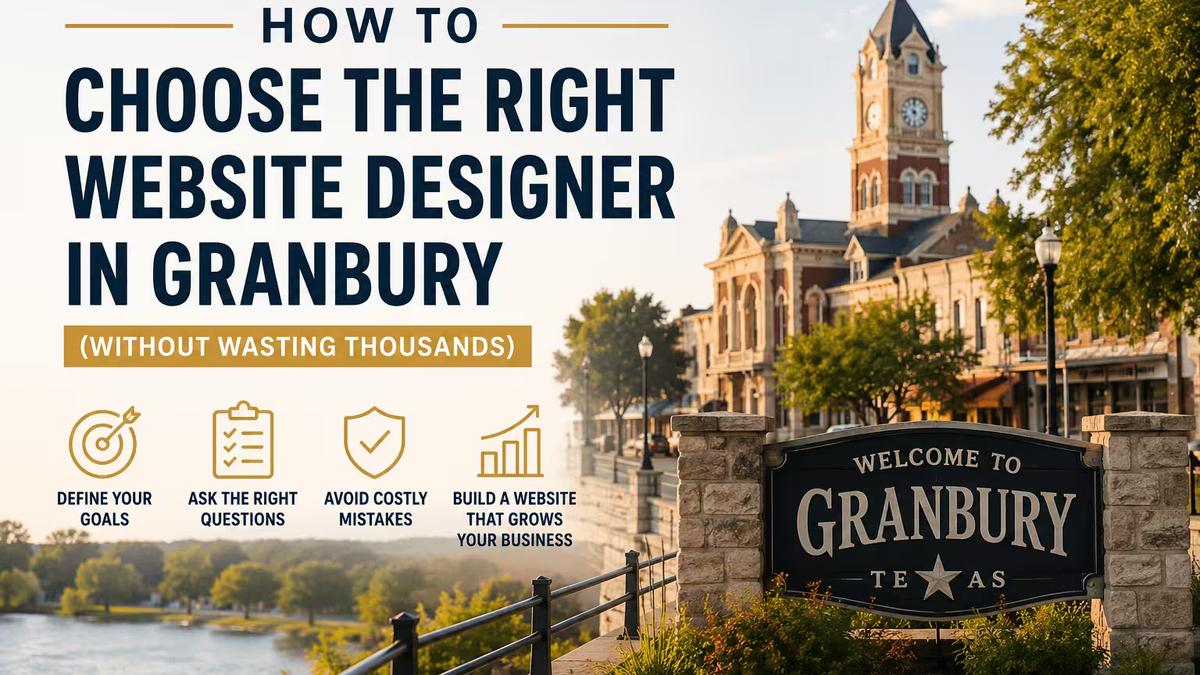
Search "website designer Granbury" and you'll get a dozen agencies promising the same three things: beautiful design, great SEO, and business growth. None of that tells you anything, because those are outcomes, not methods, and any agency can claim them without ever explaining how they'll get you there.
I've audited a lot of local business websites over the past couple of years, usually because an owner suspected something was wrong and wanted a second opinion before signing another contract. The pattern shows up constantly: two sites can look almost identical in a screenshot and perform nothing alike in the real world. One converts a steady trickle of visitors into phone calls every week. The other sits there looking professional while the owner wonders why the leads dried up. The difference is almost never visible on the surface, which is exactly why "it looks nice" is such a weak way to evaluate a website before you buy one.
Figure Out What the Site Is Actually For
Before anyone shows you color palettes or font pairings, there's a more basic question that needs an answer: what is this website supposed to do for the business? Not in the abstract, in dollars.
For a plumbing company in Hood County, that might mean showing up when someone in Granbury searches "emergency plumber near me" at 11pm on a Saturday, and having a page that loads fast enough on a cracked phone screen that the person doesn't bail before your number even loads. For a dentist, it might mean the difference between someone booking online at midnight versus closing the tab because the form timed out. These aren't hypothetical differences. A one-second delay in mobile load time can cut conversions by double digits, and Google's own research on this has been consistent for years.
If a designer wants to jump straight into layout and color before asking you a single question about how customers actually find you and what they do once they land on your site, that's worth noticing. They're designing for an audience of one: whoever approves the invoice, not the person searching for your business at night.
Appearance Is One Input, Not the Whole Output
A polished design matters, but it's a single ingredient in a system that either produces leads or doesn't. I'd rather build a slightly plainer site that loads in under a second and ranks on page one than a beautiful one that nobody finds and nobody waits for.
Speed is the one most business owners underestimate. Every extra second a page takes to load costs you visitors who never see your offer, and it also affects how Google ranks you against competitors, since page experience has been part of the algorithm for years now. I've pulled up sites for prospective clients that were taking four, five, even eight seconds to become interactive on mobile, almost always because of a bloated page builder loading a dozen scripts nobody asked for. If you want to see what that's actually costing a business in lost customers, I broke it down in more detail in what a slow, underperforming site is quietly costing you.
Structure matters just as much as speed. A site organized around what you actually offer, with service pages built for the specific things you do and the specific areas you serve, gives Google something concrete to rank. A single "Services" page with three paragraphs and a stock photo doesn't. That distinction sounds small until you realize it's usually the entire reason one competitor outranks another despite having a worse-looking site.
The Work Doesn't End at Launch
A lot of business owners assume that once the site goes live, the project is finished. It shouldn't be, because your business isn't finished changing either. You'll add a service, expand into a new town, or want to update pricing, and the question is whether your website can absorb that without another five-figure rebuild.
Ask directly who's responsible for updates a year from now, whether new pages can be added without touching the rest of the site, and whether the platform underneath was built to support SEO growth or whether that's treated as a separate upsell you'll be pitched on later. This is part of why I don't build on WordPress or drag-and-drop page builders. They're fine for a blog. For a business site that needs to stay fast, secure, and flexible as you grow, they tend to accumulate plugins, updates, and technical debt that eventually becomes its own maintenance job. I've written more about why I use a custom stack instead of WordPress if you want the technical reasoning.
Cheap Websites Are Rarely Cheap
Price matters, obviously. But the sticker price and the actual cost of a website are two different numbers, and the gap between them is where a lot of business owners get burned.
A $500 template site usually means you're one of hundreds of businesses running the exact same layout, which does nothing to differentiate you and often actively hurts your SEO since Google can tell when a site's structure and copy are recycled across dozens of domains. It usually also means slower load times, since template builders are carrying code for every feature every customer might want, not just what your site needs. The upfront savings get erased within a few months by leads that never convert, and most owners never connect the two, because the invoice and the lost business never show up on the same piece of paper. I laid out realistic pricing tiers and what actually drives cost up or down in what a website should cost in Granbury, if you want real numbers instead of a sales pitch.
Local SEO Has to Be Baked In, Not Bolted On
If your customers are in Granbury, Weatherford, Glen Rose, or Cleburne, your site needs to be built around that from the first line of code, not handed off to a separate SEO vendor six months after launch who has to work around whatever structure already exists.
That means service pages that are actually specific to what you do and where you do it, schema markup that tells Google exactly what kind of business you are and where you operate, and a site architecture that doesn't require an SEO team to reverse-engineer later. A lot of local SEO providers sell monthly retainers to fix problems that a properly built site wouldn't have had in the first place. If you're currently paying someone for SEO and want to know whether it's actually working, I put together a guide on telling a legitimate SEO agency from one running a spam playbook.
A Portfolio Is a Starting Point, Not an Answer
Screenshots are easy to make look good. What they don't tell you is whether the person built the site to actually perform, or just to photograph well for their own portfolio page. Ask to see real numbers if a designer will share them: load times, Lighthouse scores, and ideally how a comparable site performed for another client's search rankings over time. If a portfolio has nothing to say about outcomes and everything to say about aesthetics, that's a gap worth asking about directly.
What a Real Discovery Conversation Sounds Like
The intake conversation tells you more about a designer than any proposal will. If the first meeting is entirely about your color preferences and reference sites you like, you're getting a designer. If it includes real questions about what makes your business different from the competitor down the street, which services actually make you money versus which ones just take up a page, where your current customers are finding you, and what happens the moment someone fills out your contact form, you're getting someone thinking about the business, not just the interface. That distinction shapes the entire build far more than any color palette will.
How I Approach This
Every business I take on is different enough that I don't start from a template. I build custom business websites around your specific goals, your customers, and where you actually want the business to be in two years, not just how it looks on launch day. Every project I ship targets a 95+ Lighthouse score at launch, is built mobile-first since that's where most of your traffic actually lands, and is scoped and priced up front so there's no surprise invoice waiting for you halfway through. If you're weighing a WordPress rebuild against something custom, I put together an honest breakdown of what that decision costs you over the long run, not just at launch.
Ready to Talk?
If you're comparing website designers in Granbury, don't stop at the first portfolio that catches your eye. Ask about load times. Ask what happens after launch. Ask how local SEO actually gets built into the site instead of sold to you separately later.
A good website should be one of the more valuable assets your business owns, not something you're quietly replacing again in eighteen months. Book a consultation and let's talk about what your business actually needs.