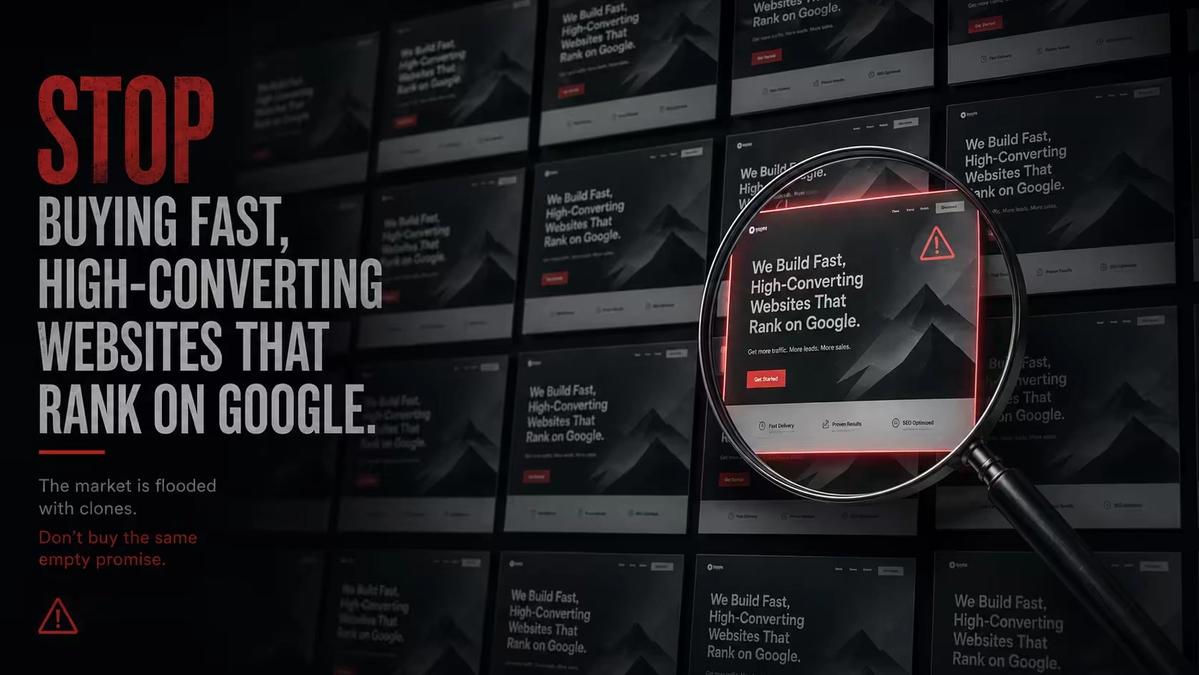
You've seen that phrase. Probably more than once this week.
Search for a web developer on Google, scroll through Upwork, browse a few agency sites, and you'll find the same sentence waiting for you everywhere: fast, high-converting websites that rank on Google. Some variation of it, anyway. Same promise, same structure, same hollow confidence.
I know because I went looking for it. Not casually. I researched the market the same way a business owner would: local web design agencies, freelancer profiles, service pages, homepage copy, portfolio pieces, performance scores, mobile layouts, SEO structure, accessibility issues, and the actual websites being delivered to businesses.
The pattern was not hard to find. A lot of the positioning was barely positioning at all. Different names, different logos, different “about us” sections, but the same promises repeated in slightly different words. Fast websites. High-converting websites. Websites that rank on Google.
Then I looked at the work behind those promises, and the pattern got worse. Slow mobile performance. Generic copy. Stock layouts. Weak service pages. Thin local SEO. Accessibility problems. Contact forms treated like decorations instead of business infrastructure.
That is what makes the phrase diagnostic. It is not just generic. It points to the kind of operation behind it. The moment a developer or agency leads with that line, they have usually told you exactly what kind of work you are going to get.
Boilerplate positioning reveals a boilerplate operation
Nobody wrote that phrase. Not really. It did not come from someone sitting down, thinking hard about what their clients actually need, and finding the most honest way to describe it. It spread because it sounds safe. Someone used it, it worked well enough, and it got copied. Then copied again. Then scraped into AI-generated agency websites and pasted into Fiverr gig descriptions across a hundred different countries.
That's what you're looking at when you see it: a signal that the operation behind it is optimized for volume, not outcomes. And that matters because the same thinking that produces templated positioning produces templated everything else.
What “fast” actually requires
Page speed is not a feature you turn on. It's the result of a series of deliberate technical decisions made before a single line of design exists.
It starts with the foundation. A site built on WordPress with a drag-and-drop page builder is carrying dead weight from day one. Bloated plugins, render-blocking scripts, unoptimized images served at the wrong dimensions, third-party tracking pixels loaded in the wrong order. Every layer of convenience added on top of a generic CMS adds latency, and most of it stays invisible until Google measures it.
Real performance comes from writing clean code against a modern framework, serving images in next-generation formats at the right sizes, minimizing JavaScript that blocks the page from rendering, and deploying on infrastructure built for speed rather than just uptime. Core Web Vitals are not a checklist item you address after launch. They're baked into every decision made during the build.
What volume operators deliver is a WordPress install with a premium theme and a caching plugin they configured once. On your customer's phone, on a real mobile network, that site loads in four seconds. Maybe five. PageSpeed scores in the fifties and sixties on mobile are common. Google is measuring on mobile. Your customer is browsing on mobile. You just paid for a slow site and were told it was fast.
What “high-converting” actually requires
Conversion copy is not a style. It's not punchy headlines and a button that says “Get Started.” Real conversion copy comes from research. It comes from understanding who your customer is, what problem they showed up with, what objection is sitting in the back of their head before they ever fill out your contact form, and what specific language resonates with that person in that industry in that market.
That's not something you paste from a template. It requires actual competitor analysis. It requires reading the reviews your competitors are getting, finding the gaps, and writing copy that speaks to exactly what your customer is already thinking.
What you get instead is this: “Welcome to [Business Name], your trusted [industry] professionals in [city].” A hero image of someone in a hard hat or a stock photo of people shaking hands. Three icon boxes explaining that they're experienced, reliable, and customer-focused. A contact form at the bottom that hasn't been tested since it was installed.
That copy doesn't mention a single specific problem the customer has. It doesn't address a single objection. It makes no argument for why this business over the one next to it. It exists to fill space and signal legitimacy, not to persuade anyone of anything. An agency that doesn't do that kind of work for their own positioning is not doing it for yours.
What “ranks on Google” actually requires
Ranking isn't magic, but it isn't generic either. A page ranks because it targets the right terms, matches the right search intent, covers the subject with enough depth, loads fast on every device, and gives Google a clear structure to understand.
That process starts with research. What does your market actually search for? How competitive are those terms? Which pages need to exist? What should those pages cover? What questions need to be answered? What locations matter? What competitors are already ranking, and why?
Volume operators don't do that work. They install an SEO plugin, fill in a few title tags, add city names to a page, write a paragraph of filler content padded with keywords, and call it optimized. They may create one services page, stuff every offer onto it, add a few city pages, and tell you the site is built to rank.
But Google does not rank an SEO plugin. Google ranks pages. And a page optimized for the wrong terms by someone who never researched your market doesn't rank for anything that matters.
Six months later, you wonder why the traffic isn't converting. The more likely answer is that it isn't coming. The site was never built around a real search strategy. It was built around a deliverable.
The clone problem
Here's the argument in its simplest form. If a developer or agency can't differentiate their own business, can't find their own voice, can't write their own positioning without sounding identical to every competitor in their space, what do you think they will do for you?
Their marketing sounds like a clone because their process produces clones. That's not a coincidence. It's the whole model.
A generic homepage. A generic services section. A generic promise. A generic process. A generic site delivered to another business that needed something specific.
The danger is that business owners often cannot see this from the outside. The portfolio looks clean. The homepage looks modern. The copy sounds professional enough. The agency says all the right things.
But when you look closer, the pattern shows up. The sites are not built around the business. They are built around the fastest path to completion.
What to look for instead
When you're evaluating who builds your site, don't stop at the portfolio. Read how they talk about themselves.
Do they have a clear point of view? Do they explain why they work the way they work? Do they push back on anything, take a position on anything, or just recite the same safe promises everyone else recites?
A developer who has actually thought about what makes a website work will sound different from everyone else. Not louder. Not more aggressive. Just different. Specific. Grounded in something other than filler.
They should be able to explain why platform choices matter, why mobile performance affects leads, why copy cannot be treated as placeholder text, why ranking requires more than an SEO plugin, why a service page needs to exist, why another page does not, and why the site should be structured around customer action instead of agency convenience.
That specificity carries over into the work. The research, the copy, the structure, the decisions made about what goes on the page and why.
Generic positioning is a preview. If that's what you're seeing before they have any reason to cut corners, pay attention to what it's telling you.
Build the website your business actually needs
Your website has one job: help the right people find you, trust you, and contact you.
That does not happen by repeating the same promises every web designer makes. It does not happen by installing the same theme, using the same builder, writing the same copy, and calling the same generic pages a strategy.
If your current site looks finished but does not help people find you, trust you, and contact you, it may not be a website problem. It may be a process problem.
I build custom websites for small businesses around the work that actually matters: speed, structure, local search, clear copy, accessibility, and the specific reasons a customer should choose you instead of the business next to you.
No WordPress. No page builders. No recycled agency template dressed up as strategy.
If you want a website built around outcomes instead of deliverables, book a consultation.