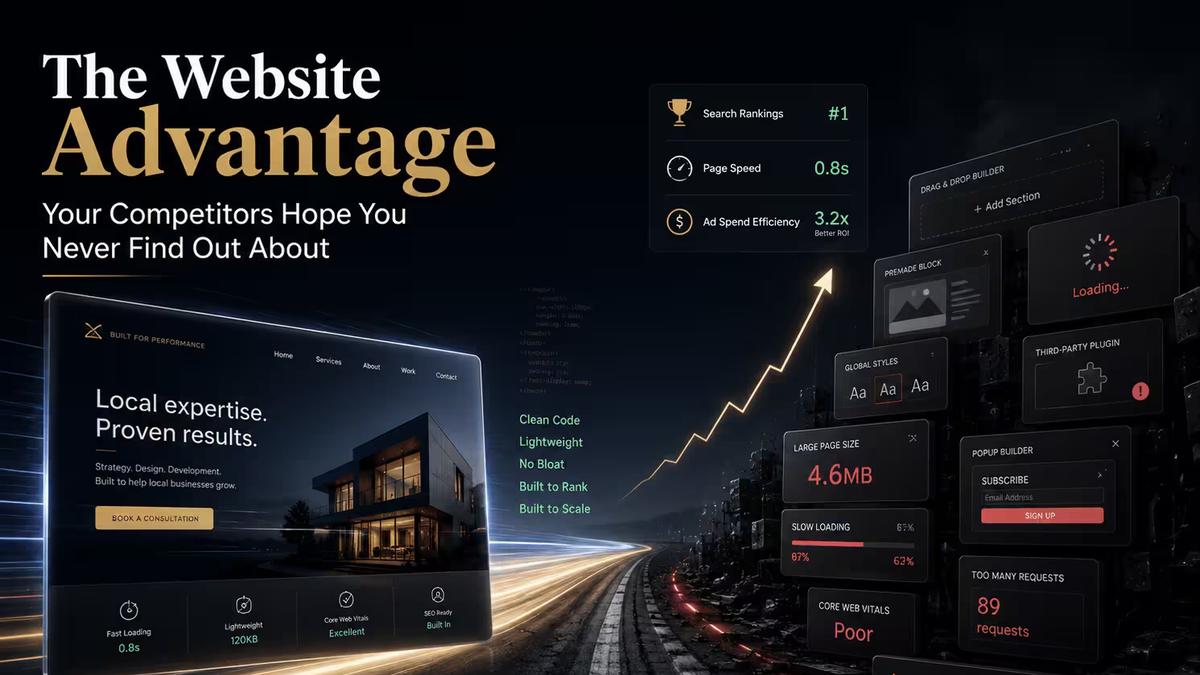
I've audited hundreds of small business websites across Granbury, Weatherford, Cleburne, and the rest of Hood County and the DFW area. Most of them were built on Wix, Squarespace, or WordPress with a drag and drop builder like Elementor or Divi. And almost every time, I find the same thing: a site that's quietly losing the owner money, every single day, in ways they have no idea about.
Here's what nobody selling those platforms is going to tell you, and what most of your local competitors don't know either.
The Gap Is Real, and Most of Your Competitors Are On the Wrong Side of It
As of late 2025, only about 44 percent of WordPress sites pass Google's Core Web Vitals on mobile, compared to roughly 65 percent for Shopify and over 60 percent for Wix, according to the Core Web Vitals Technology Report, which is built on real Chrome user data. WordPress with a builder bolted on is the most common setup I see in local markets like this one, and it's also the setup most likely to be failing. If you want the full picture on why this happens, I've broken it down in why WordPress sites are slow and why fixing it never seems to last.
That's not a small technical detail. Core Web Vitals are a Google ranking factor. So when one local business builds custom and the others are running a builder, the custom site isn't just "nicer." It has a structural advantage in search rankings that the other guy's site cannot close just by writing better blog posts. He'd have to fix the foundation first, and almost none of them do, because almost none of them know it's broken. I've seen this play out at the county level too. It's a big part of why Parker County businesses are losing search rankings to Fort Worth competitors.
I want to be straight with you: it is technically possible to optimize a page builder site well enough to compete. I've seen it happen. But in well over a hundred audits, the well optimized builder site is the rare exception, not the rule. The exceptions don't change what's typical, and what's typical is what I call the WordPress tax: a site that loads, looks fine, isn't technically broken, and is still quietly killing conversions.
Why the Gap Doesn't Close on Its Own
Here's the part that should actually get your attention if you're thinking "well, I'll just have someone optimize my site once."
A page builder site that gets optimized today degrades on its own over time. A plugin updates. The theme updates. Someone adds a new promo banner using the builder. Six months later, the site that scored well on PageSpeed is back to where it started, and nobody notices because nobody's watching. It's not a one time fix. It's an ongoing maintenance job most businesses never staff for, and most never realize what their site is actually costing them per year once lost leads are added to the hosting bill.
A custom coded site doesn't have that problem in the same way. With direct control over the code, schema, and structure from the start, there's no plugin ecosystem quietly working against you in the background. That's also why roughly 96 percent of WordPress vulnerabilities trace back to plugins and themes rather than the core software itself. Fewer moving parts means fewer things that can quietly break, slow down, or get hacked while you're not looking. This is the same reason I don't build on WordPress, and what I use instead.
So while your competitor's site slowly drifts backward, a custom site holds its ground. Over time, that gap widens, not because you did something dramatic, but because they're standing still while their platform erodes underneath them.
The Part That's Quietly Draining Their Ad Budget
This is the one that really should stay between us, because if your competitors figured this out, they'd stop wasting money tomorrow.
Google Ads Quality Score determines your cost per click, and landing page experience, meaning load speed, mobile usability, and relevance, is one of the three core factors that sets that score. Google's own research found that as load time goes from one to three seconds, the chance a mobile visitor bounces jumps by 32 percent, and at five seconds it's up 90 percent.
I've pulled PageSpeed reports for local businesses running active ad campaigns where mobile load times were well past five seconds. One DFW glass company found out the hard way when their marketing agency promised SEO but never checked if the site actually loaded. Every click on those ads was already overpriced before the visitor even saw the page, because a Quality Score of 8 can mean a meaningfully lower cost per click than a Quality Score of 4 for the same keyword and position. On top of that, a one second delay in mobile load time can cut conversions by up to 20 percent on its own.
Put those together and a slow site is a double penalty: it costs your competitor more to get the click, and then converts fewer of the people who actually show up. They're funding their own disadvantage every month and calling it "marketing."
What This Actually Means for You
If you're in a local market where most of your competition is sitting on a builder site, you don't need to out-spend them. You need a faster site with a cleaner foundation, and the gap does most of the work for you. Content and offer still matter. Content sitting on a slow, bloated platform is still content nobody waits around to read. If your site looks fine but the phone still isn't ringing, the foundation is usually where to look first, because a fast site with weak content won't carry you either. But when the foundation is solid, everything else you do, every blog post, every ad dollar, every review request, compounds instead of fighting an uphill battle against your own platform.
I'll also say this, because I think it matters: a custom site built badly can still be slow. The platform isn't magic. What matters is having someone who builds custom from the ground up and has audited enough builder sites to know exactly where they fail, so the advantage is real and not just theoretical. That's true whether you're a roofer, a dentist, or an attorney whose website is missing what most developers overlook.
If you want to know which side of this gap your site is on, book a consultation and I'll walk you through it directly, real Core Web Vitals data, what your ad spend is actually buying you, and whether your site is helping your rankings or quietly working against them while your competitors are figuring this out too.
Sources referenced:
- Core Web Vitals Technology Report data via corewebvitals.io
- wpbrigade.com, "Custom WordPress Development vs Page Builders"
- codevix.com, "Custom Web Development vs WordPress: Complete Comparison"
- bsandco.us, "Google Ads Quality Score: Why Site Speed Sets Your CPC"
- growleads.io, "The Simple Way to Fix Your Google Ads Quality Score"